



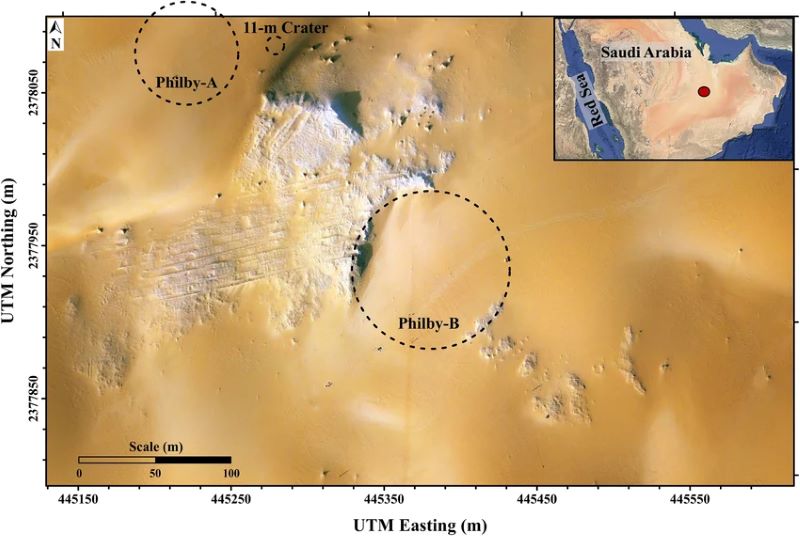
The Wabar crater field photographed from a drone in December 2019 with added position.
Members of Keighley Astronomical Society were treated to a fascinating presentation by Mr Mark Hardaker of Fordingbridge Astronomers, at the May monthly society meeting. Mr Hardacker shared the story of his expedition to the remote Wabar meteorite craters in the vast Rub’ al Khali, or “Empty Quarter”, of the Kingdom of Saudi Arabia.
Mr Hardacker began by describing how his work in multinational chemical companies had taken him to Saudi Arabia, where his family and himself lived in the eastern city Jeddah. In his free time he and colleagues would venture into the dessert and enjoy driving over the large sand dunes and camping out overnight. This lifestyle led to a colleague suggesting that they should undertake a trek to the Wabar meteorite craters. One of the most isolated and scientifically intriguing locations on Earth.
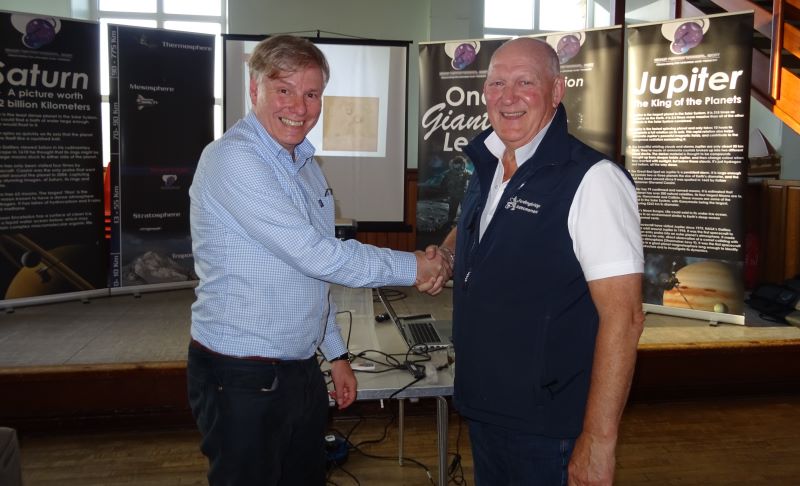
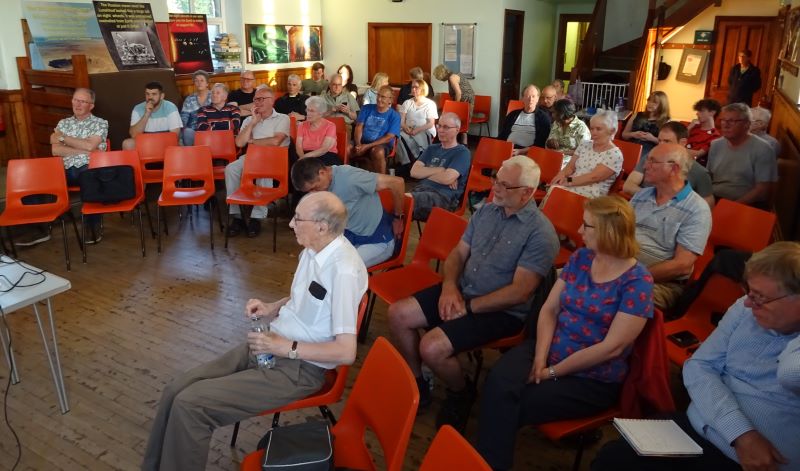
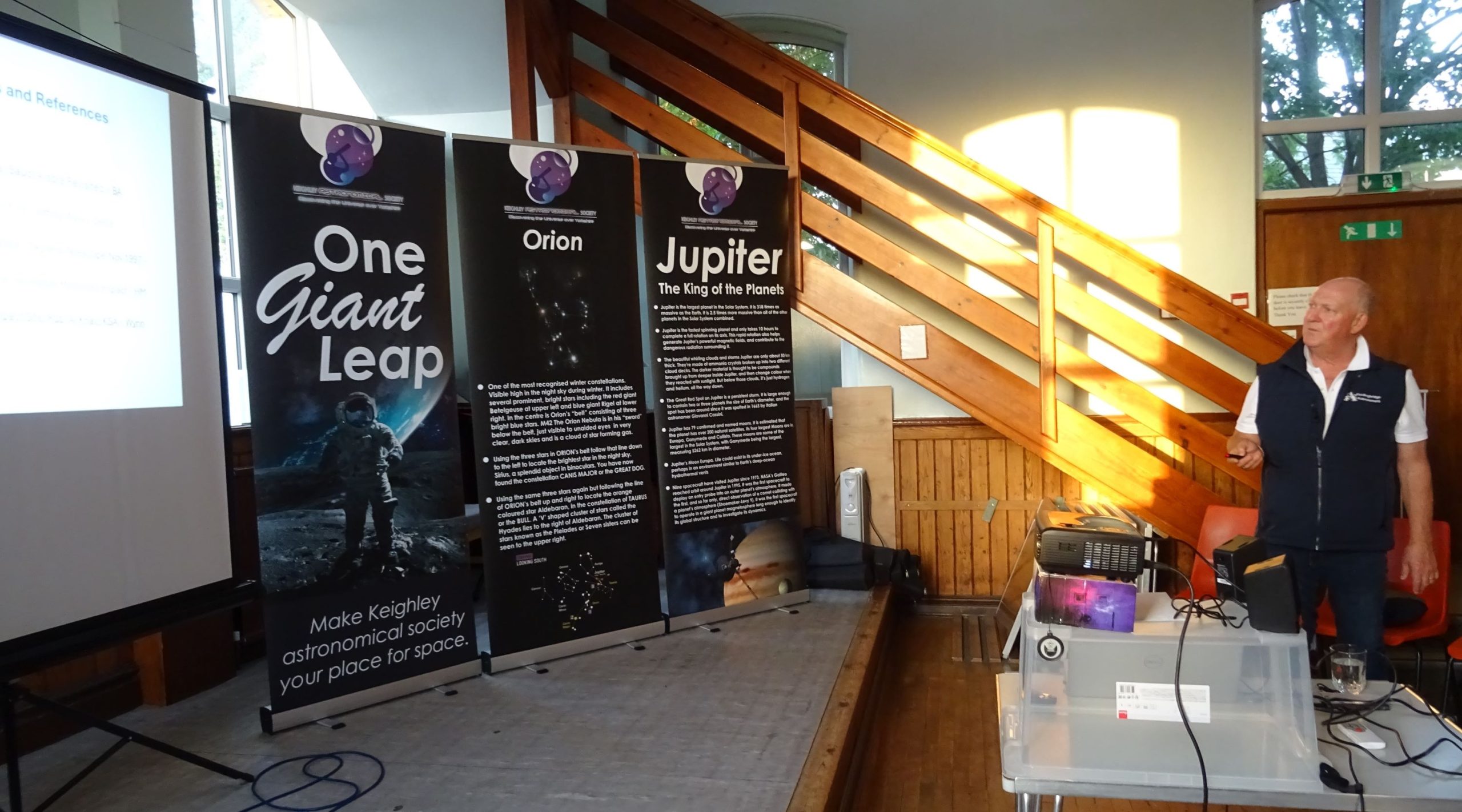
Mr Mark Hardacker FRAS from the Fordingbridge Astronomers group in Hampshire is welcomed by society chairman Dr Adrian Smith.
The journey to Wabar was itself an adventure, involving a long 1700km drive across the country by road followed by several days travelling through immense sand dunes in specially prepared four-wheel-drive vehicles.
Mr Hardacker explained that the Wabar craters were first brought to wider attention in 1932 by the explorer St John Philby while searching for the legendary lost city of Ubar.
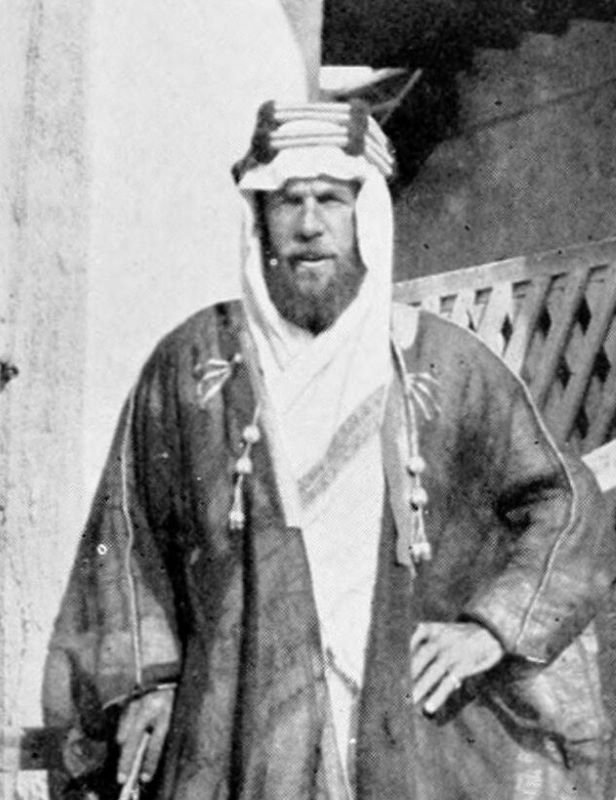
Hary St John Bridger Philby photographed in Riyadh in the 1930’s.
Harry St John Bridger Philby, (Born 3rd April 1885 to 30th September 1960), also known as Jack Philby or Sheikh Abdullah (Arabic الشيخ عبدالله), was a British Arabist, adviser, explorer, writer, and a colonial intelligence officer who served as an adviser to King Abdulaziz ibn Saud, the founder of Saudi Arabia.
At the site, Philby discovered unusual circular depressions, black glassy material, and fragments of iron meteorite, leading to the recognition that the area was the result of a meteorite impact rather than volcanic activity.
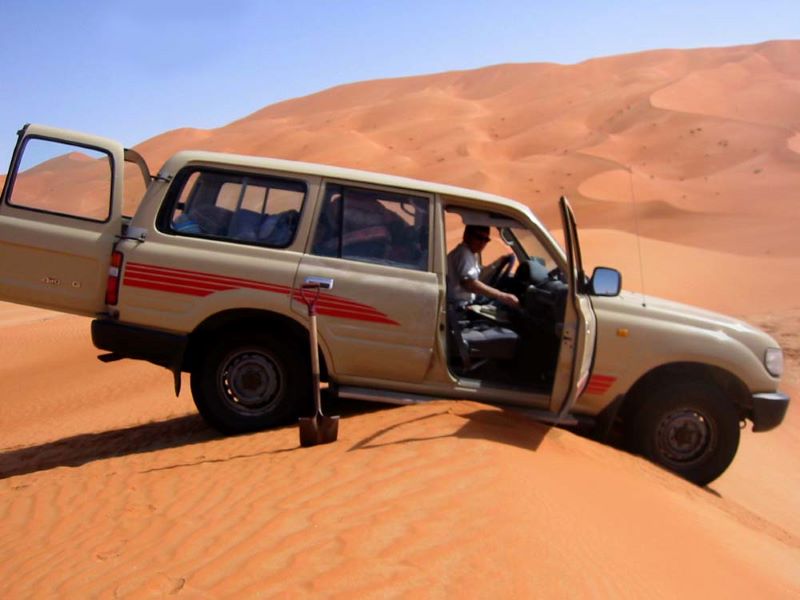
On rare occasions the vehicles would become stuck on the dunes, as in this picture. The worst could take 40 minutes of digging to get free.
A nine day trip was planned: three days to reach the craters, two days exploring the site, and three days to return, with a ninth day in reserve. Our group would be several people in three Land Cruisers equipped with high and low-range 4-wheel drives.
They planned for each car to carry four jerry cans of gasoline, four of water for each person in it, tools, car parts (full set of hoses, fuel & water pumps, etc.), a GPS unit, food, camp gear, and fiber glass skid boards. Individuals were pencilled in to bring specific items such as the car-to-car radios, tow rope, maps, table, firewood, and scuba tank to refill aired-down tires.
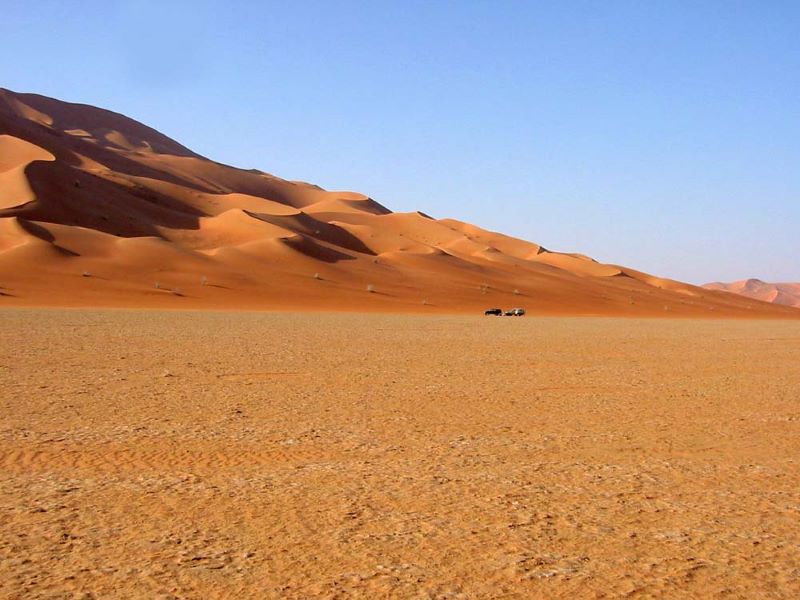
The eastern Empty Quarter.
All those jerry cans of gasoline would convert each Land Cruiser into a rolling fire-bomb explained Mr Hardacker. A basic decision for each driver was whether to transport his cans outside on a luggage rack or inside.
If they leak and ignite outside, your chance of getting away from the car is much better than if they go off inside. But if they’re inside then you’ll be more likely to smell and find any small leak before it ignites. The final decision was to get the sturdiest steel cans available, then pack them on the roof.
They drove a route along the main highway to the town of Yabreen, The end of the road and last filling station. They then continued south to across the Empty Quarter towards Wabar. Mark described the harsh conditions of the Empty Quarter, where shifting sands continually alter the landscape.
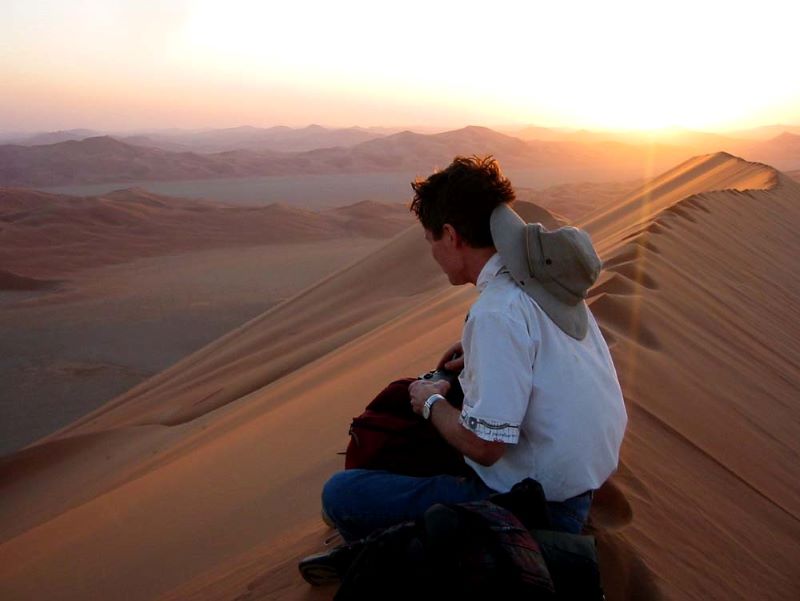
The landscape of The Empty Quarter.
Mr Hardaker explained that on moonless nights Rub’al Khali night skies are among the darkest on earth. Light pollution is non-existent, humidity nearly zero, and the stars saturate the sky all the way down to the 360 degrees of unobstructed horizon.
The latitude is further south of that in the UK, so in spring Sagittarius, Scorpius, and even Centaurus are high after midnight. Behind the first two our Milky Way galaxy glows brightly and was well delineated. Binoculars resolved most of its small, brighter patches into open star clusters, each with dozens of member stars. Even a few stars in the Omega Centauri globular were visible.
Sitting in a deck chair under such a clear sky with total silence around it was easy to grasp what the view actually was; he was gazing out from our own curved spiral arm and across a gulf of 2,500 light years to the next arm inward toward the galactic core, itself 26,000 light years away. All those star clusters he was resolving in Scorpius and Sagittarius reside in that arm at distances from us of 2,000 to 3,500 light years.
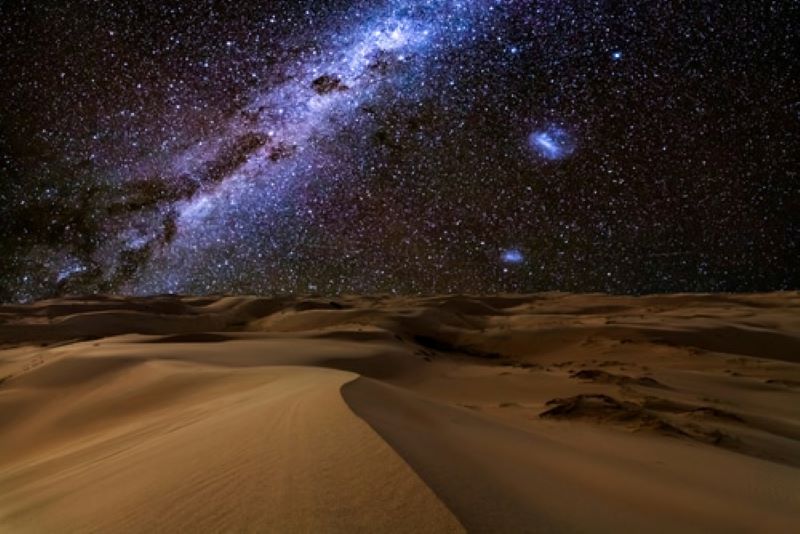
The Empty Quarter is one of the best places for stargazing because there is very low light pollution and not much city noise. The area is calm, and at night the sky is very clear.
Mr Hardacker said that whilst travelling they came across a local village. Of course no one spoke English and none of his party spoke Arabic. None the less they were warmly welcomed and stayed overnight before continuing forward.
On day five as they drove slowly along watching the GPS, he actually thought, “Something’s wrong; it should be right here.” He finally woke up and noticed the many black objects scattered across the desert to my right.
Less than two hundred meters off was a nondescript dune that looked like dozens they had passed that morning. All at once they realized that it was the dune: the seif dune that’s burying Philby “A” Crater and is drawn on all the maps. The next two days were spent walking all around this 100 meter wide celebrity and taking pictures from its crest. It must be about ten meters tall, yet its low profile is so underwhelming that I neglected to ever stand off and take its portrait. The smaller craters sounding the Philby “A” crater could still be identified.

They set up camp well to the south to avoid driving over any of the specimens. Our camp can be seen in this photo a mosaic panorama taken from on top the famous dune, facing south. It covers about 100 degrees of horizon. The crescent-shaped pattern of lighter material on the far left is the western and part of the southern rim of Philby “B” Crater, seen mostly in shadow.
The talk explored the science behind the impact. Evidence suggests that an iron meteorite struck the desert at high speed, fragmenting and creating several craters. The impact generated intense heat, melting sand into black glass and producing unusual impact rocks that can still be found scattered across the area.
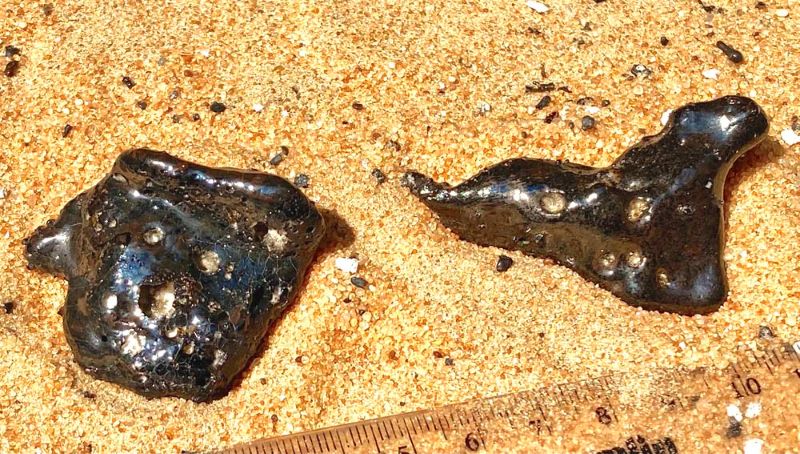
The fierceness of the fireball’s radiant heat may explain why we found some occasional pieces of impact melt that were rough on one side and smooth on the other, with almost a mirror-like sheen. One guess is that after the shock-melted globs fell onto the desert surface their upward facing sides reached even higher temperatures from radiant heating by the fireball above them.
Studies indicate that the event may have occurred only a few hundred years ago, making Wabar one of the youngest known meteorite impact sites on Earth.
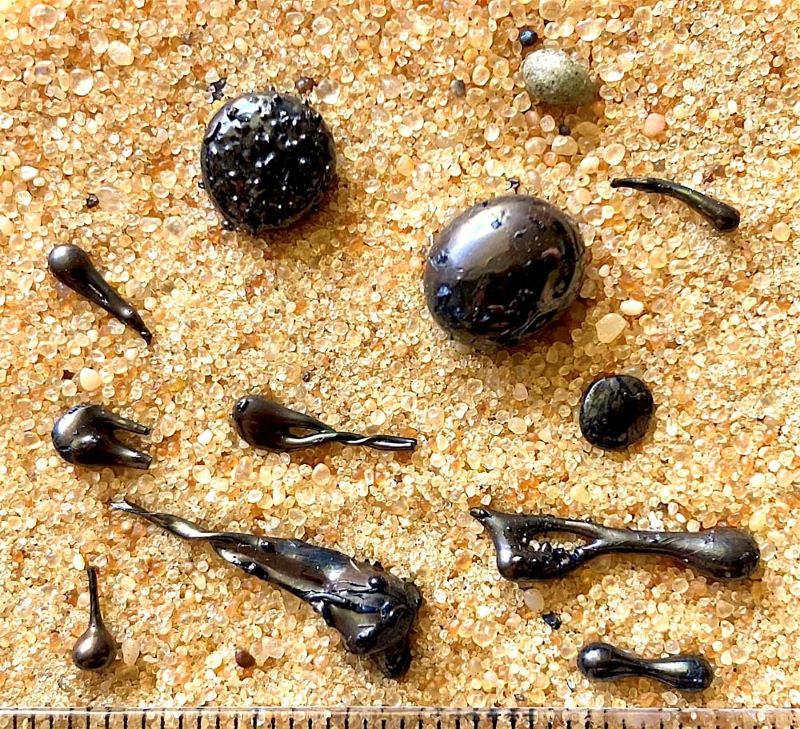
In isolated places they found the ground littered with tiny ovoids and drop shapes of impact melt like those in this photo.
Mr Haracker illustrated his presentation with photographs from the expedition, showing the dramatic desert scenery, the crater formations, and samples of impact material.
He also discussed the famous two-tonne meteorite fragment known as the “Camel’s Hump”, which was recovered from the site and is now displayed in Riyadh.
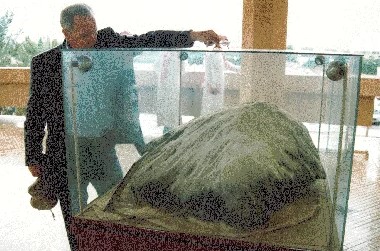
Gene Shoemaker and the so called Camels Hump. The only substantial part of the of the meteorite discovered.
Combining exploration, geology, astronomy, and personal adventure, Mark’s presentation provided a vivid account of one of the world’s most remote meteorite impact sites.
His experiences brought to life both the challenges of desert exploration and the scientific significance of the Wabar craters, making for a memorable and highly enjoyable evening for all in attendance.
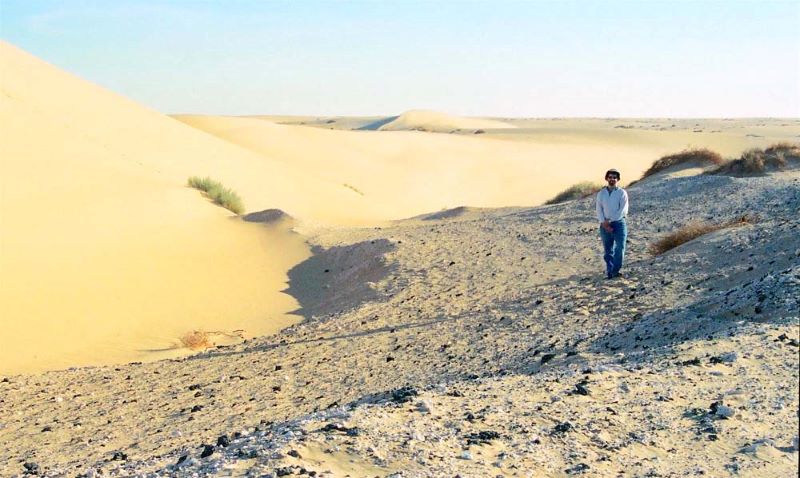
A colleague standing on the rim of the Philby ‘A’ Crater. The remainder of the crater is covered by a large sand dune.