


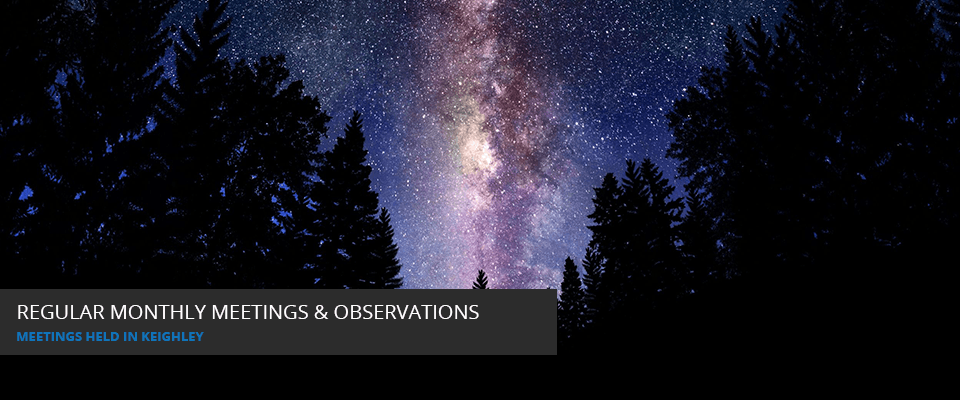

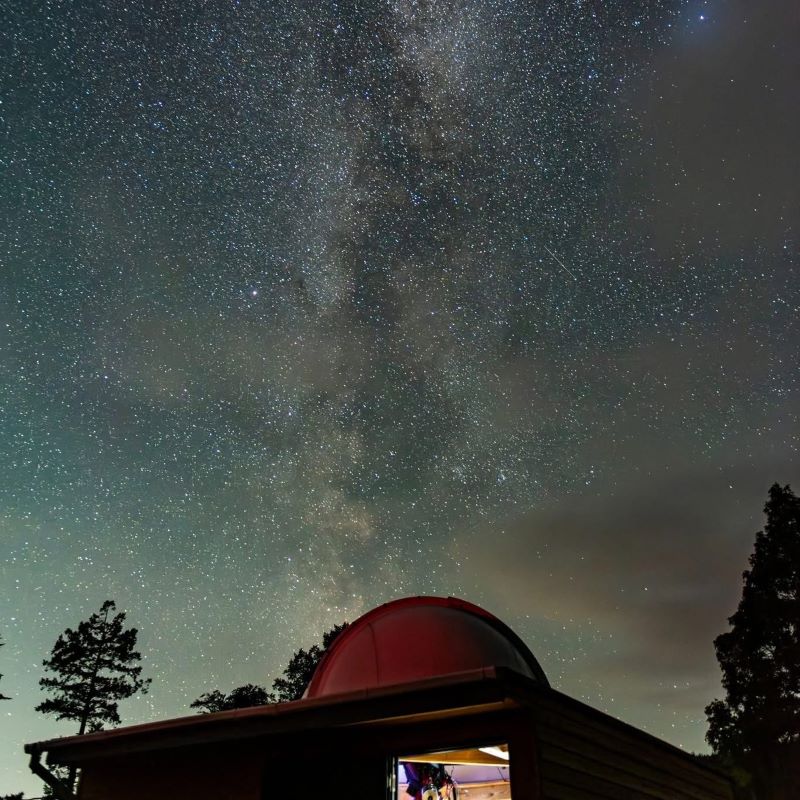
The August night sky is great for viewing the Milky Way and the Perseid meteor shower on the 12th to 13th of the month.
High summer is now with us and it will be extraordinary month for astronomy, highlighted by a deep partial solar eclipse, a perfectly dark Perseid meteor shower peak, and a partial lunar eclipse.
Early in the evening of the 12th of this month, the UK will experience its deepest solar eclipse since 2015. Up to 96% of the Sun will be covered by the Moon. The maximum coverage occurs just before sunset, with south western parts of the UK getting the deepest views.
The annual Perseid Meteor Shower peaks on the 12th and into the early hours of the 13th of this month. In a spectacular celestial coincidence, you will be viewing the meteors just hours after the solar eclipse. Because this coincides with a New Moon, the skies will be perfectly dark. You can expect to see up to 100 to 150 fast, bright meteors per hour from a dark location between midnight and dawn, from the left behind as dust pellets from the Comet Swift-Tuttle.
On the night of the 27th of August into the 28th, exactly two weeks after the solar eclipse, the Moon will pass through Earth’s shadow and bite into the Full Moon, causing a partial Lunar Eclipse.
The Milky Way arches overhead this month, looking ever more resplendent as the skies grow darker. Set against its glowing band, three brilliant stars, Vega, Deneb and Altar mark the corners of the Summer Triangle.
This is also the time of year to look at the southern constellations and the Galactic centre of the glorious Milky Way.
The constellation of Sagittarius is supposed to be a centaur. That’s a mythical half man/half horse creature, carrying a bow and arrow. Good luck spotting the centaur in the stars!
But these same stars also make up what sky watchers call the Teapot in Sagittarius; and the Teapot is simple to spot. The Teapot is an asterism in the western part of the constellation. It’s best viewed during the evening hours from about July to September. Best of all, when you’re looking toward the Teapot, you’re also looking toward the centre of our Milky Way galaxy.
The Plough lies north west with the ‘W’ of Cassiopeia at the same height in the north east. The four stars that make the square of Pegasus are becoming more noticeable in the north east and the summer triangle of stars Altair, Deneb and Vega are still very dominant in the summer sky. Arcturus is dropping to the west while Antares is now past its best.
The southern part of the sky is still taken up by the formless Hercules, Ophiuchus and Serpens. Yet more dull constellations are appearing low in the south east; these are Capricornus, and Aquarius, and although both lie in the zodiac there is nothing else to recommend them.
An indication that summer is drawing to a close is the return of Orion the hunter in the eastern pre dawn sky. Sometimes called the ‘Ghost of the shimmering summer dawn’. If you’re up early and have an unobstructed view to the east, be sure to look in that direction in the hour before dawn, The Hunter, recently behind the sun as seen from our earthly vantage point and now ascending once more before sunrise. The Hunter rises on his side, with his three Belt stars; Mintaka, Alnitak and Alnilam pointing straight up. This August, there’s a very bright object not far from the Hunter, also in the east before sunup. It’s the planet Venus. Watch for them both.
The Planets:-
MERCURY
The innermost planet remains visible, low on the horizon in the constellation of Cancer for the first couple of weeks of the month rising around 4am. Shinning at magnitude of –1.2. On the morning of 14th of the month, the innermost planet flies through M44 the Beehive cluster; and in the pre-dawn skies on the 15th August, it will be just 40 arc minutes from the planet Jupiter. For both events you will need a clear horizon to the north –east and a good pair of binoculars to fight the twilight glow. Mercury is at its greatest separation from the Sun on 2nd of the month.
VENUS
The brightness of Venus is increasing night by night this month however the evening star is looking less prominent as it sinks down into the twilight glow. Shinning at a magnitude of –4.6 it will be setting below the horizon as early as 9.30pm by the end of the month. The crescent Moon makes a lovely pairing with Venus on the 15th August, when the planet reaches its greatest separation from the Sun, and also on the 16th.
MARS
The red planet is rising about 1.30a; shinning at magnitude _1.2. Mars moves from the stars of Taurus and into the constellation of Gemini as August progresses.
JUPITER
The gas giant planet reappears in the morning sky mid-month rising about 4.30am. Jupiter with is shinning at magnitude –1.8, in the constellation of Cancer.
SATURN
Soon after Venus falls below the horizon, the ring world rises on the opposite horizon at 10pm. Located in the constellation of Pisces, at magnitude +0.6. The Moon is near to Saturn on 3rd of the month.
URANUS
You will find Uranus in the constellation of Taurus. The seventh planet rises around 11.30pm, and shines at magnitude +5.8.
NEPTUNE
You will need a pair of binoculars to spot Neptune lurking in the constellation of Pisces. It has a very faint magnitude of +7.7, and rising above the horizon about 9.30pm.
PLUTO
This distant planet can be observed in a ten-inch or larger telescope. It can be found in the constellation of Capricornus. With a magnitude of +14.4 it Rises about 8.15pm, and sets around 3.30am.
CERES
The largest object in the asteroid belt can be located in the constellation of Gemini this month. At magnitude +8.9 it rises above the horizon about 1.10am.
Special events:-
3rd August – The Moon will be near the planet Saturn.
7th August – The half Moon with be near the Pleiades star cluster.
9th August – The crescent Moon is near the planet Mars after midnight.
11th August – The thin crescent Moon is near to the planet Mercury after midnight.
16th August – The crescent Moon lies near the bright planer Venus.
20th August – The first quarter Moon is near the star Antares.
Meteor showers:-
The night of the 12th into the 13th August will be the maximum of the Perseid meteor shower. With the Moon being well out of the way eclipsing the Sun, it’s a fantastic year to be watching peak of this prolific display of shooting stars, that are high speed pellets of dust from comet Swift-Tuttle which was discovered by Lewis swift and Horrace Tuttle in 1862. The comet takes 133 years to orbit the Sun.
Phases of the Moon :-
Last quarter 6th August
New Moon 12th August
First quarter 20th August
Full Moon 28th August