



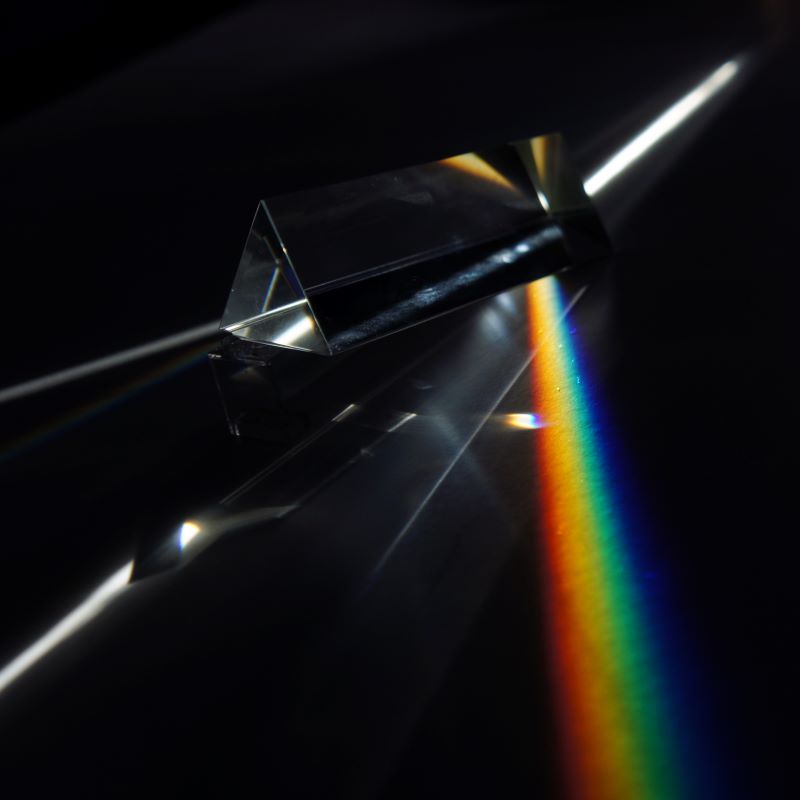
A triangular prism dispersing a beam of white light. The longer wavelengths (red) and the shorter wavelengths (green-blue) are separated.
Last night Keighley Astronomical Society welcomed Mr Rod Hine from our neighbours at Bradford Astronomical society for a presentation, “Let there be light”. The story of how mankind eventually discovered the true nature of light. With the warmth and clarity of the seasoned storyteller he is, Mr Hine guided the members present through human history and right up to the present day.
Mr Hine stated, “Light was an enigma hiding in plain sight”.
It revealed the world yet concealed its own essence, inspiring philosophers, priests, and scientists alike. The story of how we uncovered light’s true nature spans millennia and weaves together careful observation, bold conjecture, ingenious experiment, and, crucially, mathematics. It culminates in a picture at once simple and subtle: light behaves as both wave and particle, a quantum entity that resists any single classical metaphor. That destination, however, was reached by a long and winding path.
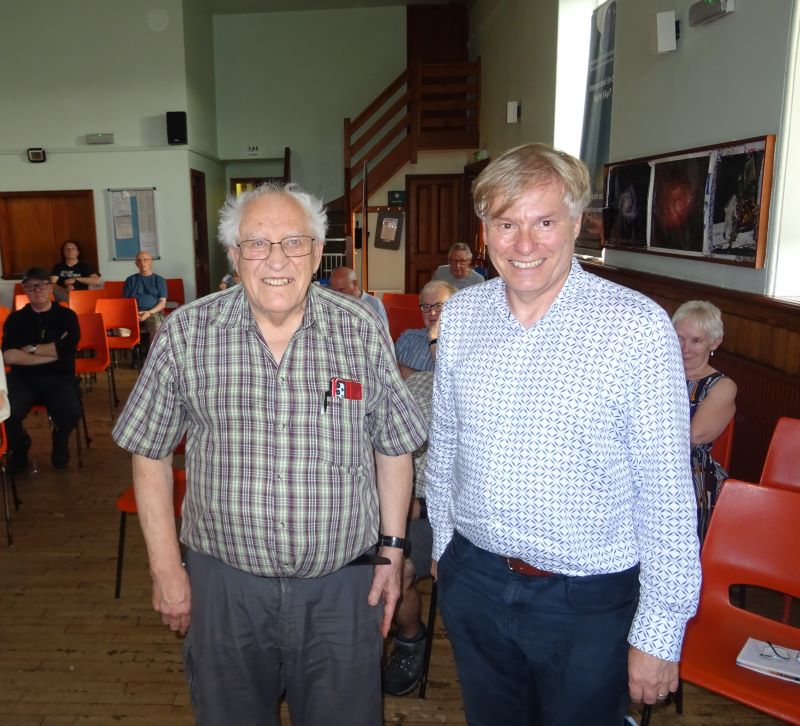
Mr Rod Hine from Bradford AS with Keighley AS chairperson Dr Adrian Smith
In the beginning
Mr Hine started the journey by referencing the Bible which states that in the beginning of creation, when God made the heavens and Earth. The earth was without form and void, with darkness over the face of the abyss and a mighty wind that swept over the surface of the waters
God said ‘Let there be light’, and there was light and God saw that the light was good, and he separated light from darkness.
God Said ‘Let there be Light’.
Ancient understandings of light
Beginning with ancient intuitions and Greek theories of vision, Mr Hine explained how early ideas gave way to the first quantitative breakthroughs.
Pythagoras (c. 570–495 BC) proposed the ‘Emission theory of vision’. He theorized that light and sight are generated by continuous, invisible beams or “visual rays” emitted directly from the human eyes that strike objects to make them visible. Mr Hine stated, his explanation of light and vision involved several key concepts.
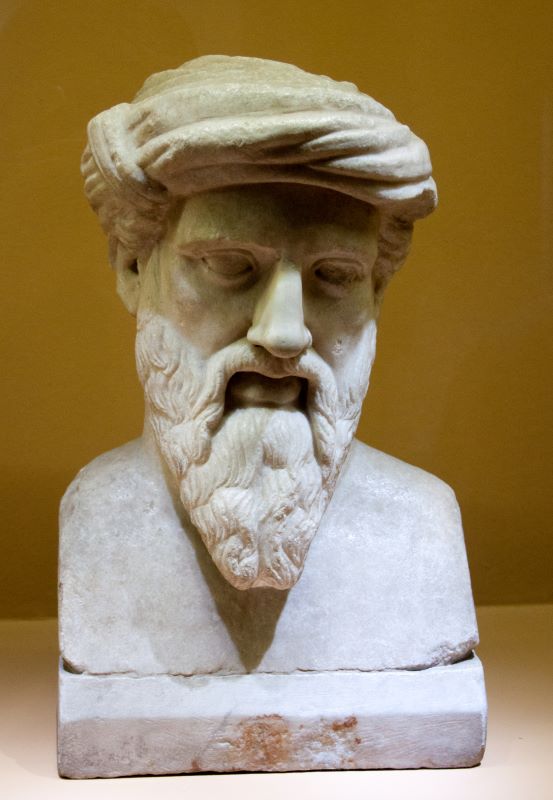
Bust of Pythagoras of Samos in the
Capitoline Museums, Rome
The Internal Fire: He believed that human eyes contained an internal “fire” or luminous substance. This fire projected rays outward to illuminate the surrounding space.
Active Perception: Unlike modern physics (where light reflects off an object and enters the eye) Pythagoras thought viewed vision as an active, outward-reaching process.
Anaxagoras (c. 500–428 BC) explained light through natural, astronomical observation rather than mythology. He taught that the Sun was a massive, red-hot stone rather than a god, and that the Moon was a dark, rocky body like the Earth. He correctly deduced that the Moon has no light of its own, but instead shines by reflecting the light of the Sun.
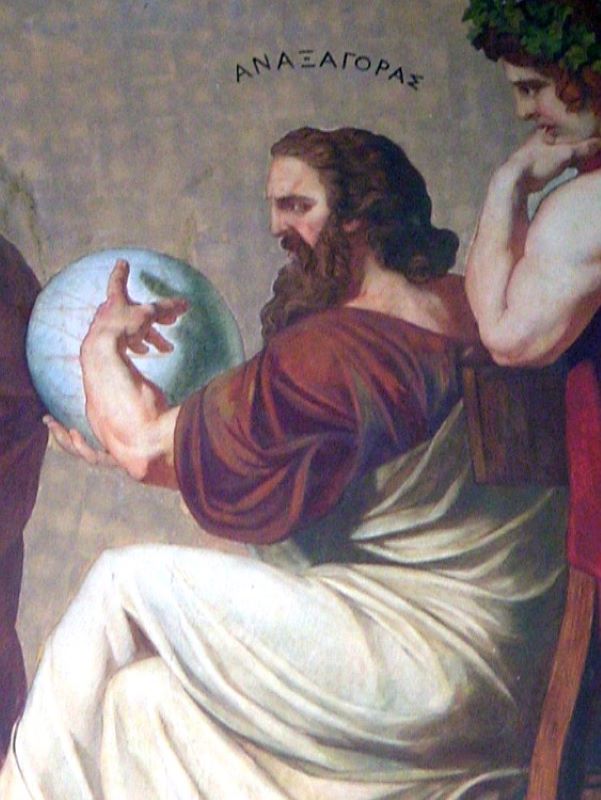
Anaxagoras; part of a fresco in the portico of the National University of Athens
The Sun as a Luminous Body: Anaxagoras proposed that the Sun was essentially a blazing, red-hot mass of metal or stone. He theorized that this fiery, luminous state was sustained by the sheer speed and friction of the cosmic rotation (or vortex) that originally formed the universe. He also calculated that the Sun was massive (estimating it to be larger than the Peloponnese peninsula in southern Greece).
The Moon and Reflected Light: A central pillar of his astronomy was the understanding that light on Earth and other bodies comes directly from the Sun.
Reflection: Anaxagoras explicitly stated that the Sun “induces the moon with brightness”. He realized that the Moon acts as a mirror, catching and reflecting the Sun’s rays across space.
Phases and Eclipses: Because of this reflection theory, he was the first person known to correctly explain the phases of the Moon as well as solar and lunar eclipses. He deduced that lunar eclipses occur when the Earth moves directly between the Sun and the Moon, casting a shadow on the lunar surface.
Anaxagoras transformed the understanding of the Sun and Moon from mythological figures into natural, physical objects explained Mr Hine.
The Golden Age of Arabic Science
Mr Hine moved forwards in time to a period when in what we now know as the middle east there was an era of unprecedented intellectual growth lasting from the 8th to the 14th centuries. Mr Hine focused on the works of Ibn al-Haythams (Latinized as Alhazen) (c. 965 – c. 1040). He was a mathematician, astronomer, and physicist of the Islamic Golden Age from present-day Iraq. Referred to as “the father of modern optics”. He was born in Basra and was educated in Baghdad. He was originally destined to become a religious minister, however he turned to science, engineering and the study of Aristotle’s writings.
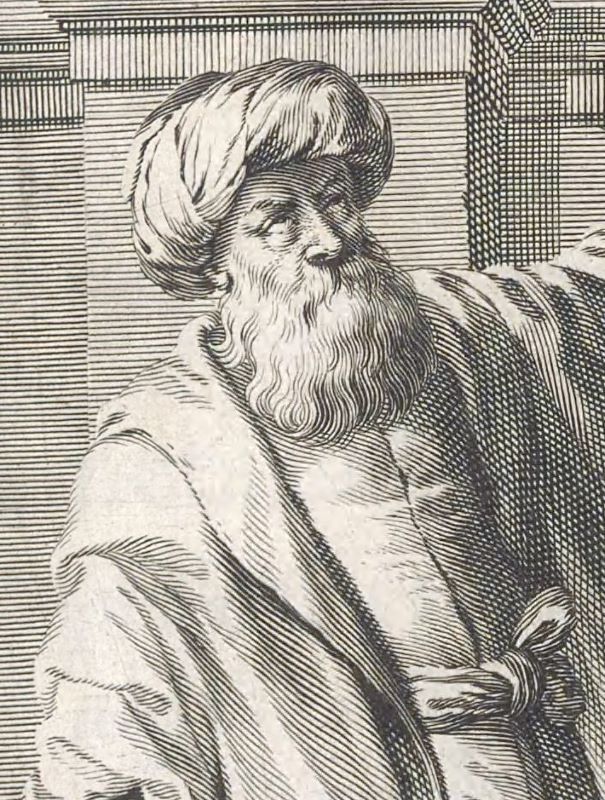
Alhazen
Ḥasan Ibn al-Haytham
ابن الهيثم (Engraving by Jeremias Falck after Adolph Boÿ, 1647)
Ibn al-Haythams definitively disproved the previous theories by proposing we only see objects when light from a luminous source (like the sun or a candle) bounces off them and travels into our eyes. He conducted detailed anatomical studies, concluding that the eye acts much like an optical instrument where the lens focuses light to form an image.
Rectilinear Propagation of Light: Ibn al-Haythams demonstrated that light travels in straight lines (rectilinear propagation). To prove this, he designed an experiment using multiple lanterns placed at different heights outside a darkened room. By shining the light through a small pinhole, he noticed that each lantern illuminated a specific spot on the opposite wall, forming straight lines through the hole.
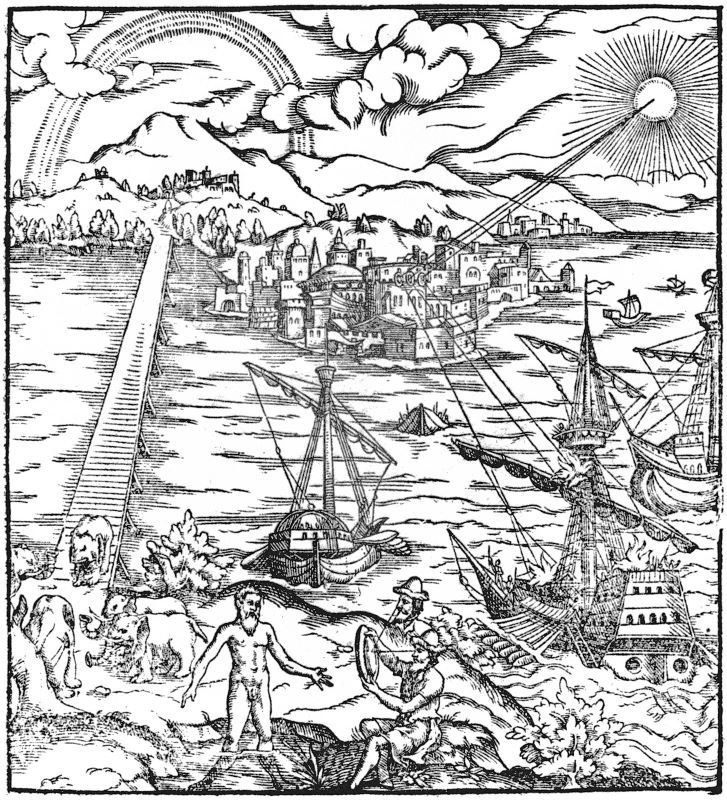
Front page of the Opticae Thesaurus, which included the first printed Latin translation of Alhazen’s Book of Optics. The illustration incorporates many examples of optical phenomena including perspective effects, the rainbow, mirrors, and refraction.
This also served as the first clear experimental description of the camera obscura.
Ibn Al-Haythams legacy: Mr Hine said that by 1200 Europe was coming out of the dark ages. His works were translated into Latin and were a great influence on many scholars and philosophers between 1200 and 1500. Principally Roger Bacon (1220 to 1292).
Optics
Around the year 1200 saw the first uses of lenses made from polished quartz pebbles in China. In 1268 Roger Bacon refers to eye-glasses. In the year 1352 the first known portrait of a person with eye-glasses was pained by the Italian artist Tomasso da Modena. In 1480 Ghirlandajo painted St Jerome with glasses. St Jerome became the patron saint of spectacle makers.1517 Raphael paints Pope Leo X holding a reading glass.
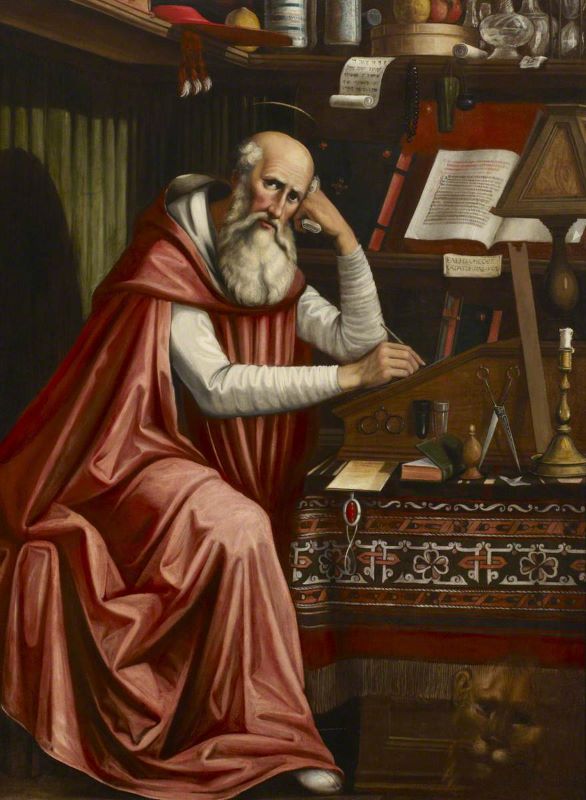
Saint Jerome in His Study, by the Italian Renaissance painter Domenico Ghirlandaio, executed in 1480 and located in the church of Ognissanti, Florence. Below his right hand can be seen a pair of ‘eye glasses’
Galileo Galilei
Galileo lived from 1564 to 1642 in Pisa and then in Venice and later in Florence. Mr Hine pointed out that Galileo didn’t actually invent the telescope it had come from Holland originally about the turn of the century. The first recorded telescopes were indeed invented in the Netherlands (historically known as Holland) in 1608. The invention of the “spyglass” or refracting telescope centered around a group of Dutch spectacle-makers.
Hans Lippershey: A spectacle-maker in Middelburg, submitted the earliest known patent application for a telescope on 2nd October 1608. His instrument used a combination of convex and concave lenses and could magnify objects about 3 times.
Jacob Metius: A few weeks later, another Dutch instrument-maker from Alkmaar also filed a patent for a similar device.
Galileo was the first to use a telescope to systematically study the sky from 1610. The telescope he used had a magnification about 30x.

Ole Romer 1676
In 1676, Danish astronomer Ole Rømer made the historic discovery that light travels at a finite, measurable speed, shattering the long-held belief by philosophers like René Descartes that light moves instantaneously. Working at the Paris Observatory alongside Giovanni Domenico Cassini, Rømer was originally tracking the orbital cycles of Jupiter’s innermost major moon, Io, to solve a critical maritime navigation problem: creating a reliable tracking system for calculating longitude at sea.
The Observations of Io
While analysing years of orbital data, Rømer noticed a systematic flaw in predictive mathematical tables.
The Anomaly: When Earth was closest to Jupiter, the eclipses of Io occurred ahead of schedule.
The Delay: When Earth was farthest from Jupiter, the eclipses lagged behind, occurring later than expected.
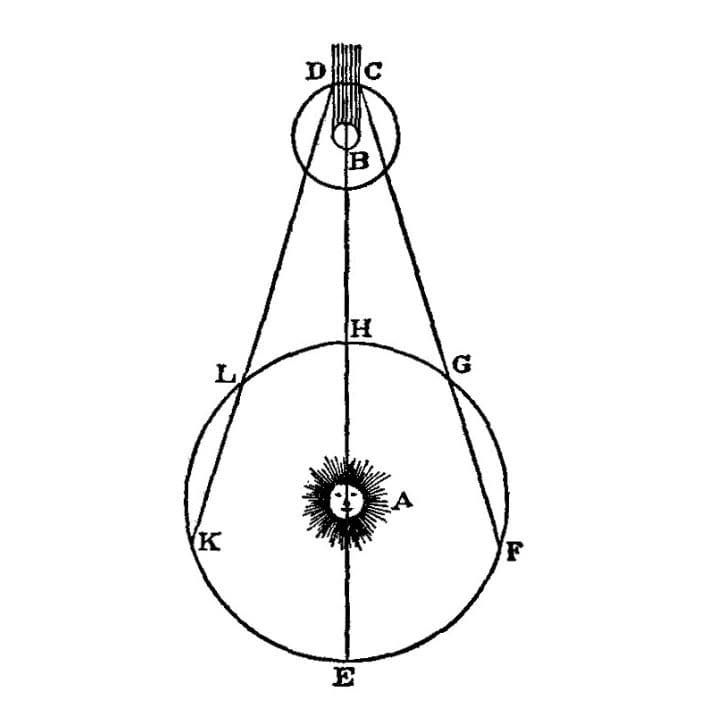
In 1676, while working at the Paris Observatory, Ole Rømer calculated the speed of light by observing the eclipses of Jupiter’s moon Io
The Prediction: To prove his theory to sceptical peers, Rømer successfully announced to the French Academy of Sciences that the Io eclipse on 9th November 1676 would occur exactly 10 minutes later than traditional calculations predicted.
The Core Logic: Rømer deduced that the physical properties of Io’s orbit had not changed. Instead, the discrepancy was entirely a light-time effect. The time lag occurred because light required extra time to travel across the added distance of Earth’s orbital path when the two planets moved away from one another.
Based on his data, he calculated that it takes light approximately 22 minutes to cross the entire diameter of Earth’s orbit (a distance known today to take closer to 16 minutes and 40 seconds).
The Resulting Calculation: Rømer’s primary focus was proving that the speed of light was finite, so his original 1676 paper did not actually list a definitive velocity figure. However, using his 22-minute estimate, fellow scientists soon computed the implicit speed.
Isaac Newton (1643 to 1727)
Isaac Newton revolutionized optics by demonstrating that white light is a mix of all spectrum colours explained Mr Hine, and theorizing that light consisted of tiny particles called corpuscles. His brilliant experiments proved colour is an inherent property of light, not an impurity added by prisms.

The English physicist Isaac Newton (1642-1727) decomposing light with a prism of glass. Engraving from 1880 by Unknown artist
Mr Hine pointed to Newton’s primary concepts on light.
The Corpuscular Theory: Newton argued that light was made of extremely small, fast-moving particles (corpuscles). He believed these particles obeyed the basic laws of motion, which neatly explained why light reflects off mirrors at equal angles (like a bouncing ball).
Light and Colour (Prism Experiments): Before Newton, people believed prisms modified or “corrupted” white light to create colour. Newton proved this false using an ingenious “crucial experiment”. He split sunlight into a rainbow using a prism, isolated a single colour, and passed it through a second prism. Because the colour remained unchanged, he proved that colour is an intrinsic property of light itself.
Recomposition: He proved that white light is composite by using a second, inverted prism to recombine the separated colours of the spectrum back into white light.
The Visible Spectrum: Newton identified the seven primary colours of the rainbow: red, orange, yellow, green, blue, indigo, and violet.
While Newton correctly deduced that colour comes from light, explained Mr Hine; his particle theory fell short of explaining wave phenomena like diffraction (the bending of light around obstacles). Decades later, the scientific community favoured wave theories proposed by his contemporaries, which eventually paved the way for the modern understanding of wave-particle duality.
The aberration of light
In 1727, English astronomer James Bradley discovered the aberration of light (specifically stellar aberration), which provided the first direct, observational proof that the Earth revolves around the Sun. This foundational astronomical discovery occurred entirely by accident while Bradley was attempting to measure stellar parallax.
Thomas Young (1773–1829)
Mr Hine described Thomas Young as the last man who knew everything. He was polymath and physician who made foundational breakthroughs across an astonishing variety of fields, from physics and optics to linguistics and Egyptology. His most notable achievements include:
Wave Nature of Light: He conducted the famous double-slit experiment, demonstrating that light behaves as a wave rather than just a stream of particles.
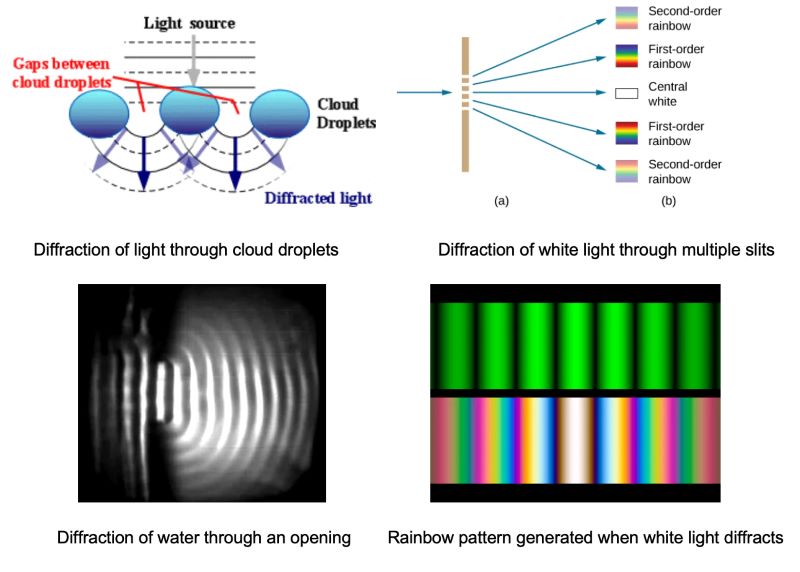
Diffraction of Light – Thomas Young’s Double Slit Experiment
Vision & Colour: Discovered the eye’s ability to change focus (accommodation) and described astigmatism. He also proposed the three-colour theory of vision, later known as the Young-Helmholtz theory.
Polarized light
Polarized light is light waves in which the vibrations are restricted to a single plane, unlike unpolarized light where vibrations occur in all directions. This means the oscillating electromagnetic waves are aligned in a specific, uniform orientation as they travel through space.
Mr Hine explained that light travels as a transverse wave, vibrating up and down, side to side, and at every angle in between. Unpolarized Light: Standard sources like the sun or light bulbs emit waves vibrating randomly in all directions. Polarized Light: It passes through a specific filter or reflects off a surface, sorting the waves so they all wiggle in the same direction (e.g., purely horizontal or purely vertical).
Light can become polarized naturally or artificially through four main methods said Mr Hine.
Reflection: When light reflects off flat, non-metallic surfaces like water, glass, or a wet road, it becomes heavily polarized, usually in a horizontal direction.
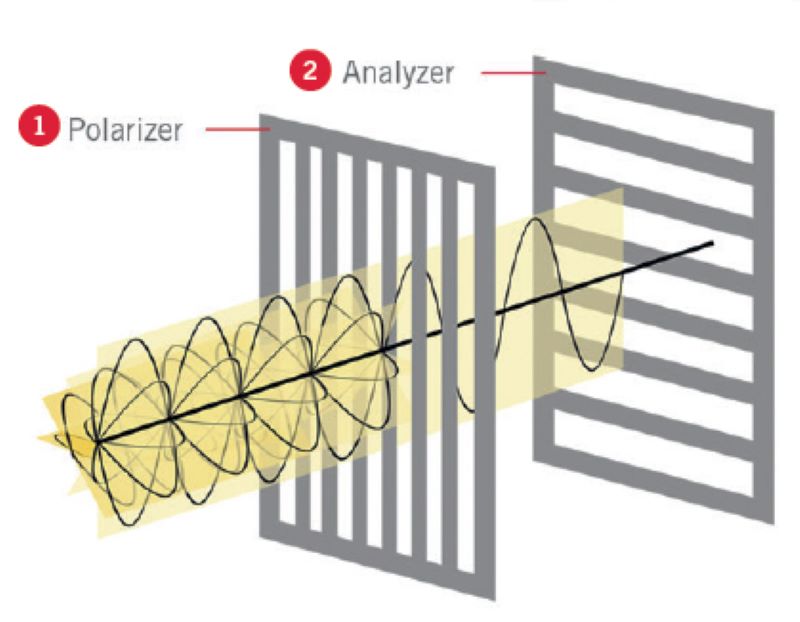
Polarised light is light in which the vibrations of the electric field waves are restricted to a single plane or direction
Transmission (Polarizers): Specialized materials (like the film in polarized sunglasses) act like a microscopic “picket fence.” They only allow waves vibrating in one specific direction to pass through while blocking the rest.
Scattering: Sunlight bouncing off air molecules in the atmosphere becomes polarized. This is why the sky looks different through polarized camera filters.
Birefringence: Some crystalline materials (like calcite) split a single ray of light into two separate, polarized rays.
Common Applications
Sunglasses: Vertically oriented polarized lenses block horizontally polarized light (the harsh glare that bounces off roads or water), significantly reducing eye strain.
Photography: Photographers use circular polarizers on camera lenses to cut through reflections on water or glass and to make skies appear deeper blue.
3D Movies: RealD 3D glasses use different polarization directions for each lens, ensuring the left and right eyes only see the correct image to create the illusion of depth.
LCD Screens: The screens on your TV, phone, or laptop rely on polarized layers and liquid crystals to control light and display the images you see.
Michael Faraday 1845
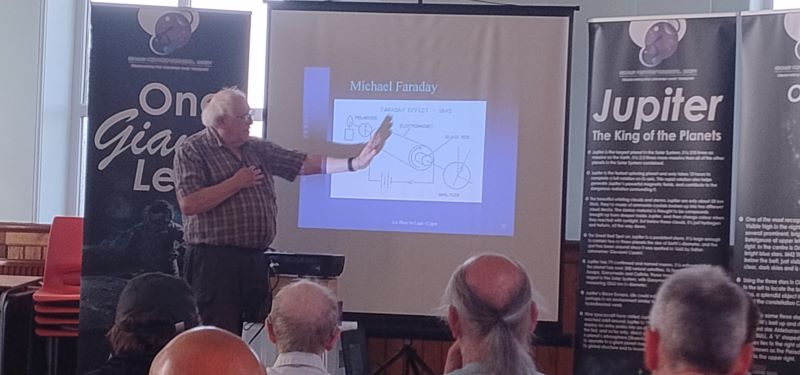
In 1845, English scientist Michael Faraday discovered that a magnetic field could rotate the plane of polarized light, a breakthrough known today as the Faraday effect or Faraday rotation. This elegant experiment provided the very first experimental evidence that electromagnetism and light are fundamentally connected, paving the way for modern physics and James Clerk Maxwell’s unified electromagnetic theory.
Faraday sought to prove that all forces of nature are interconnected, said Mr Hine. In his magnetic laboratory at the Royal Institution, he devised the following setup.
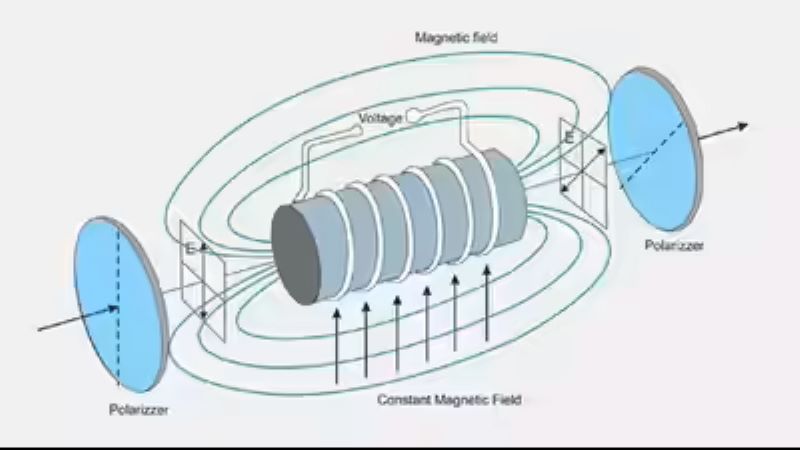
Michael Faraday discovered this phenomenon in 1845, and it is known today as the Faraday effect (or Faraday rotation). This groundbreaking discovery provided the very first experimental proof that electromagnetism and light are fundamentally linked
The Medium: A dense piece of heavy optical-quality glass (lead borate flint glass) that he had developed years earlier.
The Light: A beam of linearly polarized light, which vibrates in only a single plane.
The Magnet: A powerful electromagnet positioned so its magnetic field lines ran parallel to the direction the light was travelling.
Initially, Faraday crossed two polarizers (an analyser and a polarizer) at 90 degrees to block all light from passing through. When he turned on the electric current to activate the magnet, light suddenly leaked through the analyser. To block the light again, he had to physically rotate the analyser eyepiece. This proved that the magnetic field had twisted the light’s orientation. He famously recorded in his notebook: “I have at last succeeded in… magnetising a ray of light”.
James Clerk Maxwell 1865
James Clerk Maxwell revolutionized physics by proving that electricity, magnetism, and light are all manifestations of the same phenomenon, electromagnetic waves. His groundbreaking equations established that fluctuating electric and magnetic fields self-propagate through space as transverse waves travelling at the speed of light.
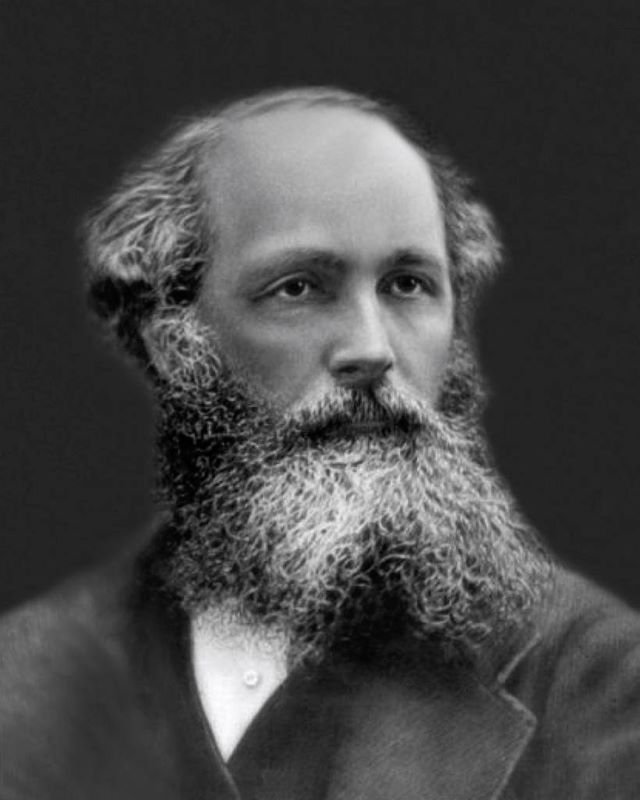
James Clerk Maxwell FRS FRSE (1831 to 1879) was a Scottish physicist and mathematician who was responsible for the classical theory of electromagnetic radiation
Maxwell’s equations
Maxwell settled on a set of 20 equations, which were comprehensive, but hard going stated Mr Hine. In the 1880’s Oliver Heaviside devised a new ‘operational calculus’ system. Using this notation, Maxwell’s 20 equations can be expressed as just 4 with much greater insight into the actual physics.
Maxwell – A summary
He accounts for the speed of light in vacuum and all wavelike properties of electro magnetic radiation.
The ether remained a mystery for another 30 years, as scientists still kept looking for it- but they did find
Radio waves discovered by Hertz in 1883.
X-Rays discoved by Roentgen in 1895
Gamma Rays discovered by Rutherford 1903
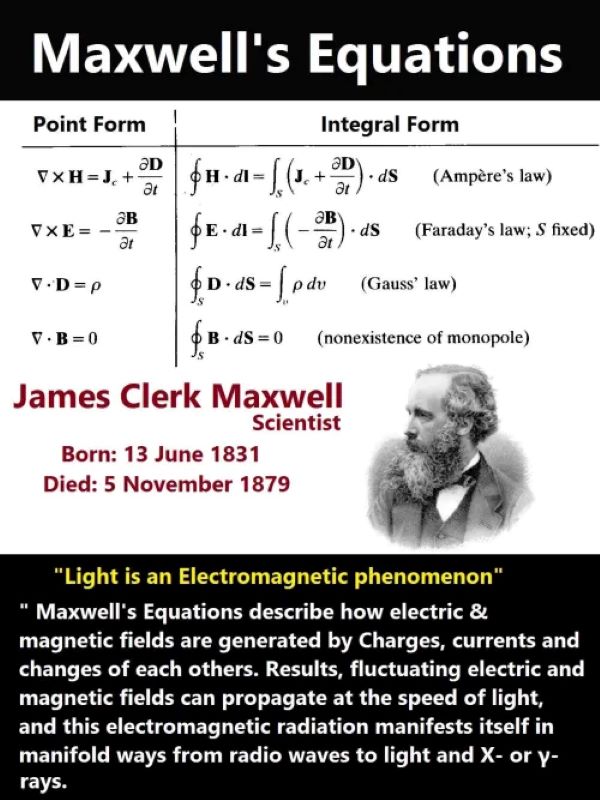
Maxwell derived four laws which became the basis of electromagnetic theory. He discovered that all electromagnetic radiation moves at the speed of light, c, in free space. Einstein based his theories of relativity on Maxwell’s work and cited him as a genius.
Electromagnetic (EM) waves
Mr Hine explained that Electromagnetic waves are self-propagating ripples of energy that travel through space, formed by the synchronous oscillation of electric and magnetic fields. Unlike mechanical waves (such as sound or water waves), they do not require a physical medium to travel through, allowing them to propagate easily through the vacuum of space.
Core Characteristics of EM Waves are their transverse nature and their universal speed.
Transverse Nature: The electric and magnetic fields vibrate at right angles (90°) to each other, and both are perpendicular to the direction the wave is moving.
Universal Speed: All EM waves travel at the absolute speed of light (c) in a vacuum, which is approximately 3 × 10⁸ m/s (around 186,000 miles per second).
In a complete and utter vacuum EM waves do not interact with electric or magnetic fields. In the presence of matter there are several interesting ways that EM waves are affected stated Mr Hine.
Kerr effect – electric field
Faraday rotation – magnetic fields
Stark effect – emission lines affected by electric fields
Zeeman effect – emission lines affected by magnetic fields
Secondary effects due to temperature and Doppler shift
Happily for astronomers, in interstellar space the Faraday effect is caused by free electrons, and the relationship simplifies toB =RM λ 2
RM = Rotation Measure
Lambada is the wavelength.
The ultraviolet catastrophe
This was a fundamental failure of classical physics in the late 19th century. It describes the incorrect theoretical prediction that a perfect, heated object (a “black body”) would emit infinite amounts of energy at extremely high frequencies; specifically in the ultraviolet range.
Real-world experiments showed that objects do not incinerate themselves by radiating infinite ultraviolet light. Instead, radiation peaks at a certain frequency and drops off at higher frequencies.
This catastrophic discrepancy proved that classical laws were incomplete. In 1900, physicist Max Planck resolved the crisis by proposing a radical idea: energy is not continuous, but is instead emitted in discrete packets called quanta.
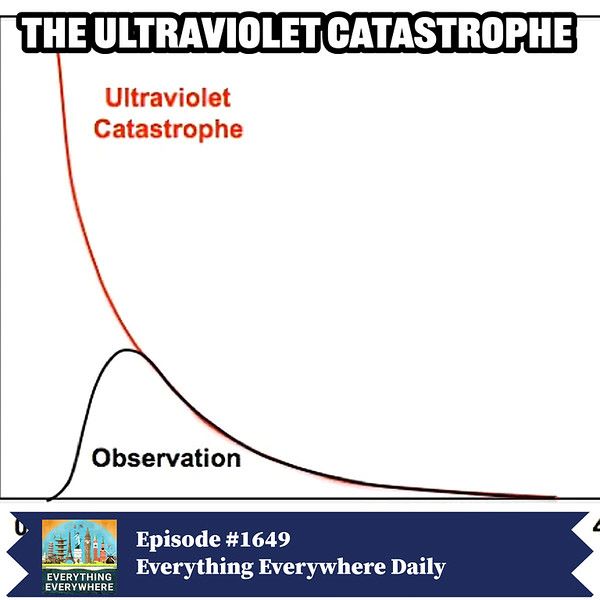
The “ultraviolet catastrophe” was a fundamental failure of classical physics around the year 1900. This theoretical prediction was an absurdity because it violated the fundamental laws of energy conservation and meant that objects should spontaneously radiate lethal amounts of high-frequency light
Planck’s revolutionary equation, E = hν, established that energy is directly proportional to frequency (E is energy, h is Planck’s constant, and ν is frequency). Because a high-frequency wave requires a specific minimum “packet” of energy to be created, and the object has a finite amount of energy available, the creation of high-frequency ultraviolet waves is choked off. This brilliant mathematical fix successfully bridged the gap between theory and experiment, ultimately birthing the field of quantum mechanics.
Einstein 1905
The speed of light is a constant anyway, so forget about the either –it doesn’t exist!
Light is affected by gravity; proved by the 1921 eclipse observations.
But Einstein never fully embraced modern Quantum Theory.
Quantum theory
Quantum theory, also known as quantum mechanics, is the fundamental framework of modern physics that describes the bizarre, non-intuitive behaviour of matter and energy at the atomic and subatomic levels. At this microscopic scale, the universe operates on probabilities rather than the fixed, predictable rules of classical physics.
Core Concepts are :-
Wave-Particle Duality: Light and matter can behave as both point-like particles and waves, depending on how they are measured.
Superposition: Particles do not exist in just one fixed state. Instead, they can exist in a combination of multiple states simultaneously until they are observed or measured.
Quantum Entanglement: Two or more particles can become deeply intertwined. The state of one particle instantly influences the state of the other, regardless of the physical distance separating them.
Heisenberg Uncertainty Principle: It is impossible to simultaneously measure certain pairs of properties (like a particle’s exact position and momentum) with absolute precision.
Quantum Tunneling: Particles can sometimes pass through or overcome physical barriers that would be impossible to breach under classical laws.
While it may seem purely abstract or theoretical, Mr Hine explained that quantum mechanics is the foundation of much of our modern technology. It underpins everything from lasers and semiconductors (which run computers and smartphones) to medical imaging (MRI scanners) and quantum computing.
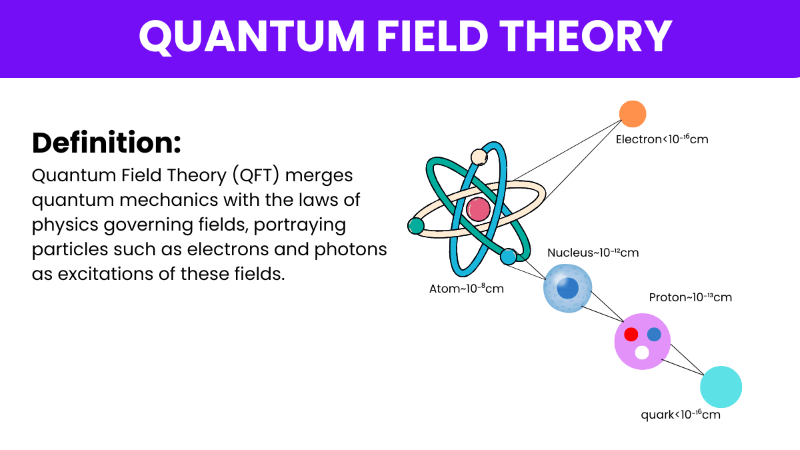
Quantum Field Theory
In quantum theory, emission and absorption lines are the spectral fingerprints of atoms caused by electrons jumping between fixed, quantized energy levels. When an electron changes its orbit, it must either absorb or emit a packet of light energy called a photon.
Quantum Mechanism
According to quantum mechanics, electrons in an atom cannot exist just anywhere. They are restricted to specific, discrete orbits known as quantized energy levels.
Absorption: An electron absorbs a photon of a specific energy and jumps from a lower energy level to a higher energy level.
Emission: An electron drops from a higher energy level to a lower energy level, releasing its excess energy as a new photon.
The energy of the photon (\(\Delta E\)) corresponds exactly to the difference between the two atomic energy levels (\(E_{\text{high}}\) and \(E_{\text{low}}\)), defined by the Planck-Einstein relation:
\(\Delta E=E_{\text{high}}-E_{\text{low}}=h\nu =\frac{hc}{\lambda }\)
Where \(h\) is Planck’s constant, \(\nu \) is the frequency of the light, \(c\) is the speed of light, and \(\lambda \) is the wavelength. Because these energy gaps are unique for every element, the resulting wavelengths create unique visual lines.
Differences Between the Two Lines
Feature Emission Lines Absorption Lines.
Electron Movement Higher to lower energy level Lower to higher energy level.
Photon Action Photon is released Photon is absorbed.
Visual Appearance Bright, coloured lines on a dark background Dark lines on a continuous rainbow background.
Physical Context Hot, glowing gas Cool gas blocking a bright light source.
Summary of the Concept
Emission and absorption lines are the direct visual proof of quantum theory, showing that atomic energy levels are quantized rather than continuous. Each element produces a unique pattern of lines because its internal electron energy configuration is unique.
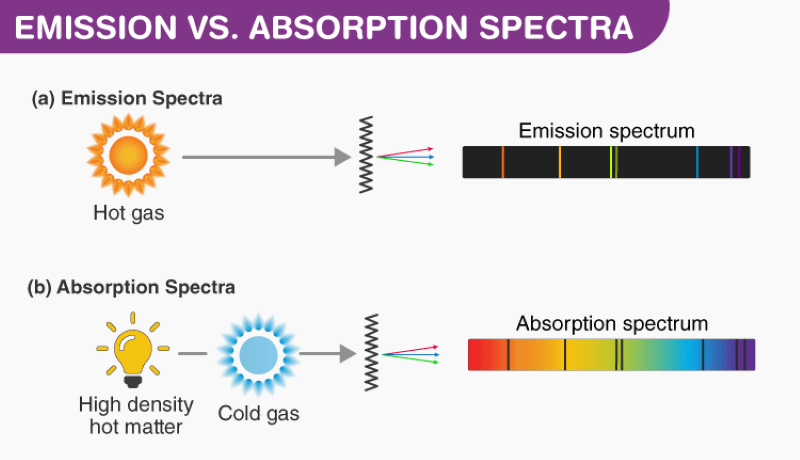
The main difference between emission and absorption spectra is that an emission spectrum has different coloured lines in the spectrum, whereas an absorption spectrum has dark-coloured lines in the spectrum.
What light tells us…
The Doppler shift of spectral lines tell us about the velocity of the object. Some exo-planets are discovered by measuring the tiny wobble of the parent stars, and dark matter was discovered by its effect on the rotation of galaxies. ‘Red shift’ is also an indicator to the expansion of the universe proposed by Hubble in the 1930’s.
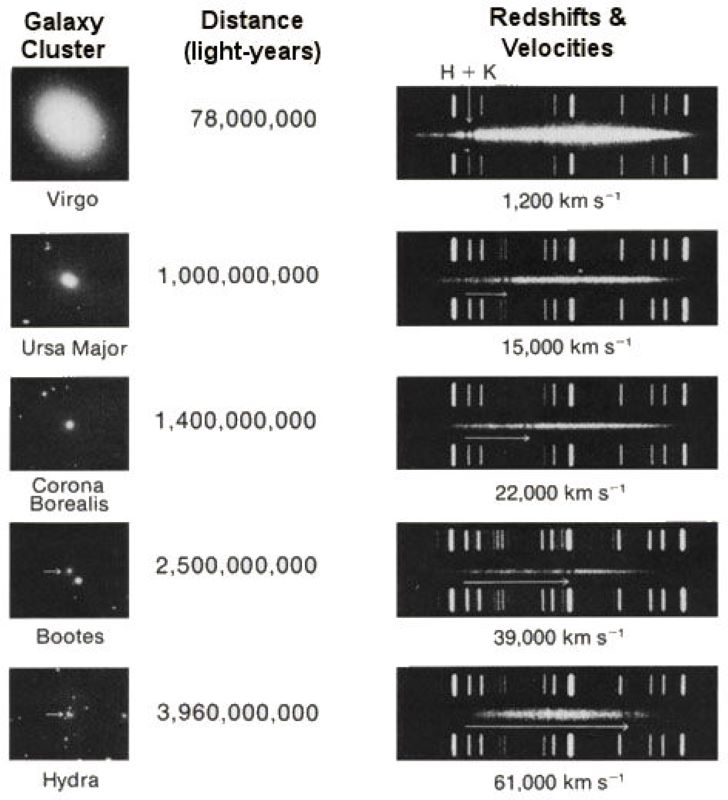
Hubble’s Law of cosmological expansion was first formulated by Edwin Hubble in 1929. He compared the distances to galaxies to their redshift and found a linear relationship. He interpreted the redshift as being caused by the receding velocity of the galaxies.
Taken altogether, explained Mr Hine almost everything we know about distant planets, stars, nebulae and galaxies is deduced from observing the electro- magnetic spectrum in one form or another.
The exceptions are neutrinos, and perhaps gravity waves in the near future?
Q&A highlights
Several of our members asked lively questions on the subject matter and were comprehensively answered by Mr Hine.
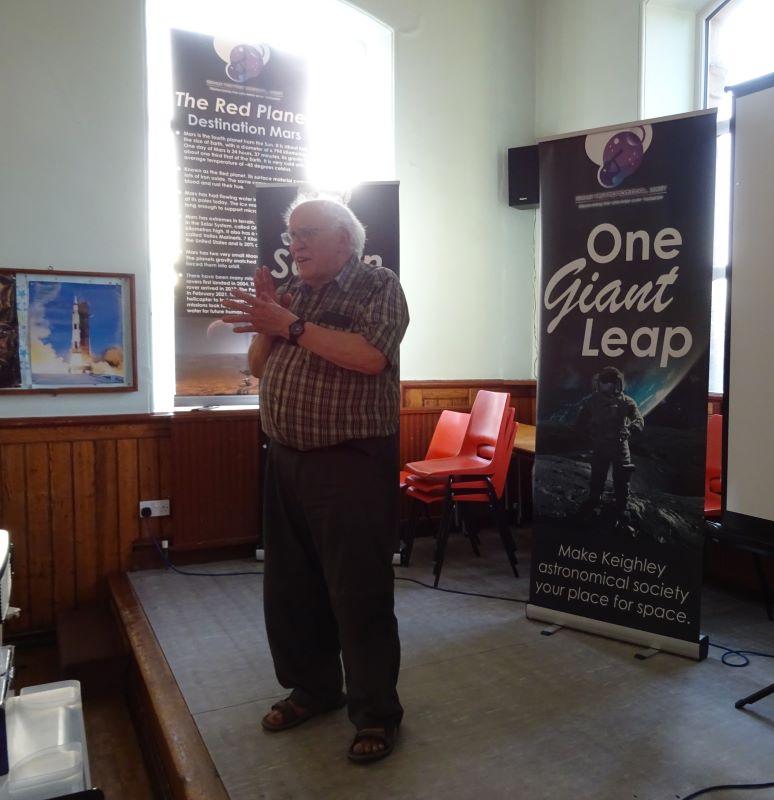
Keighley Astronomical Society extends heartfelt thanks to Mr Rod Hine for stepping in after the scheduled speaker was unable to attend. It certainly was an evening that was as informative as it was inspiring, and to Mr Hind for fostering such rich outreach.
Presentations like this remind us why we gather; to share curiosity, argue gently with the cosmos, and leave with slightly larger minds than we arrived with.
What’s next?
Our next meeting will be on 1st October 2026. The speaker will be our own society chairperson Dr Adrian Smith with a presentation titled. “Is it time to forget about dark matter”?
New visitors are always welcome; bring your interest, bring your curiosity and bring your questions.