


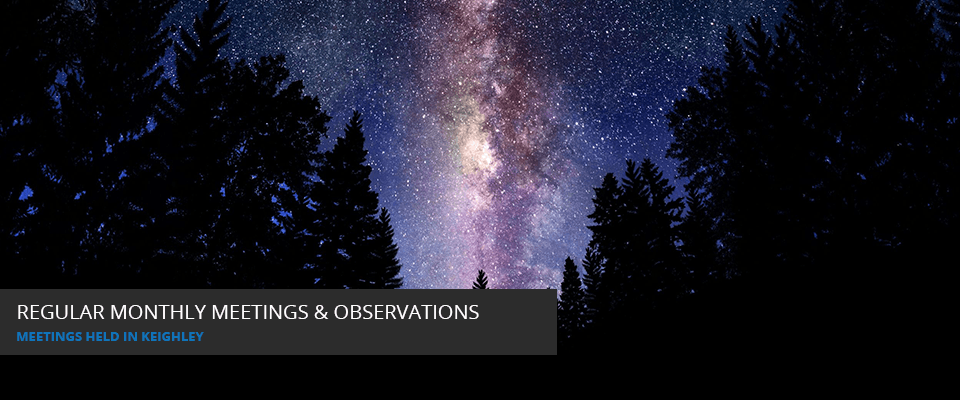



This month’s night skies are illuminated by brilliant Venus and Jupiter. The southern part of the heavens is dominated by the brilliant orange star Arcturus. Well to its lower right, are the blue-white stars Spica and Regulus. But the region to the left of Arcturus boats only the faint stars of two giant constellations, Ophiuchus and Hercules.
Stars:-
May is the first month when the constellation of Orion is absent from the night sky altogether, and of the prominent winter stars only Capella in Auriga the Charioteer and Castor and Pollux in Gemini remain above the western horizon. The Plough or Ursa Major (the Great Bear) is still more or less overhead with the pointers pointing to the North Star. The ‘W’ of Cassiopeia is now very low down although still easily visible in the north western sky.
It is also a good month to look for another of the circumpolar constellations; Draco the Dragon. Circumpolar constellations such as the Plough, Cassiopeia and Draco are visible all year around; this is because these stars are above the Earth in space.
Draco is represented by a stream of stars that winds its way around the North Star, so although it has no really bright stars it is still quite easy to identify. The stream starts roughly between the pointers of the Plough and the North Star, then winds its way past the Plough making off in the general direction of Cepheus.
It then turns and ends up at the ‘Dragon’s Head’, a quadrilateral of four stars near the bright star Vega, which is one of the stars that forms the Summer Triangle.
There is one notable star to mention in Draco and this is Thuban, which is not prominent in brightness and is located between Mizar, in the Plough, and the orange star Kocab, in Ursa Minor.
Use the Plough, to draw a line down following the curve of the handle to the bright orange star Arcturus in Bootes the Herdsman which is now very high up. Your downward curve will take you to Spica in Virgo the Virgin. Both Arcturus and Spica are almost due south.
High in the South West can be found Leo the Lion with its bright star Regulus, at the base of a distinctive looking ‘backwards question mark’ of stars. The small quadrilateral of stars that form Corvus the Crow is still quite conspicuous low in the south, while further to the south west and low down is the orange star Alphard, the brightest star in the constellation of Hydra the Water Snake. Alphard is often called ‘The Solitary One’ because of the lack of bright stars near it.
In the North East, two of the stars that form the summer triangle can be seen; Vega, in Lyra the Lyre, has reached a respectable altitude and Deneb in Cygnus the Swan is now becoming noticeable. The third point in the triangle, Altair in Aquila the Eagle, has yet to appear.
Planets:-
MERCURY
The innermost planet joins Venus from the 20th of this month, low down to its lower right. By the end of the month, Mercury is shinning at magnitude –0.6 and will be setting below the horizon around 11pm.
VENUS
The evening star is at its most impressive this month blazing at magnitude –3.9in a totally dark sky and by the end of May, setting as late as midnight. The crescent Moon lies near Venus on 18th and 19th of the month. During the last few nights of this month, Venus and Jupiter are moving towards each other in preparation for a close conjunction next month.
MARS
The red planet will be too close to the Sun for observation this month.
JUPITER
The gas giant planet can be found in the constellation of Gemini, just to the lower left of the constellations twin stars, Caster and Pollux. Shinning at magnitude –1-9 Jupiter falls below the horizon about 1am. The crescent Moon lies to the right of Jupiter on the 19th of the month, and to its upper left on 20th May.
SATURN
In the middle of this month the ring world begins to emerge from the twilight into the dawn sky in the constellation Pisces. Saturn lies to the lower right of the crescent Moon on the morning of 14th May. By the end of the month, Saturn is rising around 3am.
URANUS
This distant world will be lost in the Suns glare this month.
NEPTUNE
The outermost planet will be too close to the Sun to be seen this month.
PLUTO
Can be found in the constellation of Capricornus. It will always be low down in the west and only visible in a ten-inch or larger telescope in a truly dark sky for a short period of time. Pluto rises above the horizon about 2.25am and has a magnitude of +14.5.
CERES
The largest object in the asteroid belt can be located in the constellation of Taurus this month, at Magnitude +8.6. However it will below the horizon during the dark hours and not favourable for observation this month.
Special Events:-
Halley’s Comet reappears this month!. Well not the actual beast, but dirt from its skirt which burns up above our heads as a shower called the Eta Aquarids. This shower, which will peak in the early hours of the mornings of The 6th of May, is predicted to be unusually intense this year. Unfortunately the bright moonlight will spoil this year’s show.
Phases of the Moon: –
Full Moon 1st May
Last quarter 9th May
New Moon 16th May
First quarter 23rd May
Full Moon 31st May