





Drug discovery in outer Space. What makes Microgravity an emerging tool?
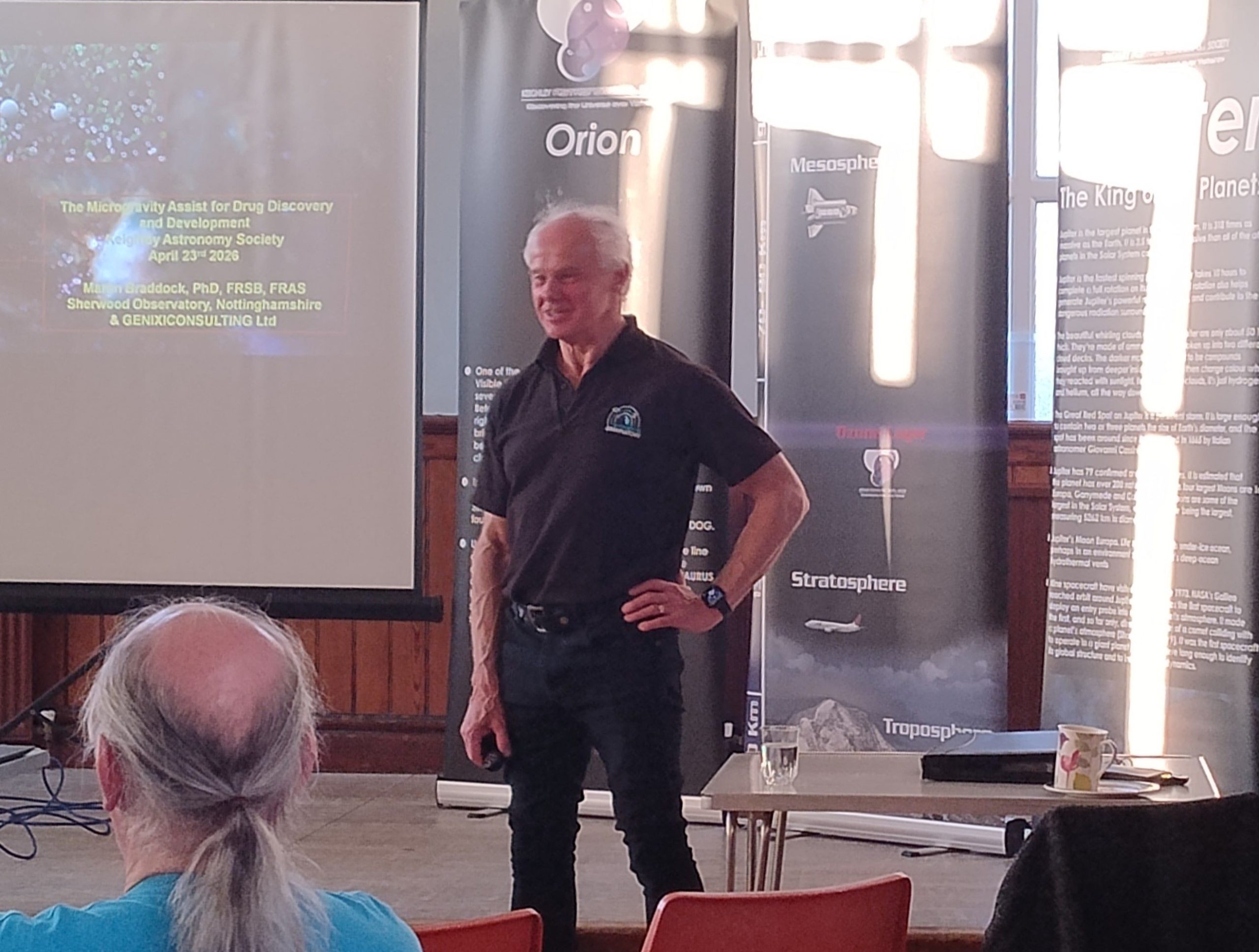
That was the question posed by Dr Martin Braddock BSc, PhD, FRSB, FRAS at the April meeting of Keighley Astronomical society.

Dr Braddock has been a regular visitor to Keighley Astronomical society for several years. A professional scientist and former Royal Society University Research Fellow at the University of Oxford. He is founder and director of GENIXICONSULTING LTD and a member of The Sherwood Observatory group.
Dr Braddock explained that the Microgravity Assist refers to the use of the space environment (specifically the state of near weightlessness) to overcome physical limitations that hinder drug discovery and development on Earth. By removing the dominant force of gravity, researchers can manipulate biological and chemical processes in ways that are impossible in terrestrial labs, leading to higher-quality pharmaceuticals and more effective therapies.

What are the Key Benefits of the Microgravity Environment?
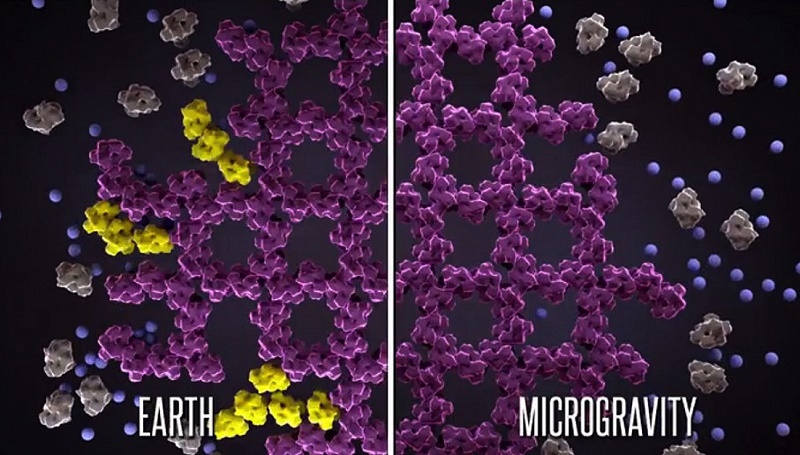
Superior Protein Crystallisation: In microgravity, the absence of convection and sedimentation allows proteins to form larger, more uniform, and higher-quality crystals. This is critical for X-ray crystallography, which scientists use to map a protein’s 3D structure and design drugs that fit precisely into target sites.
Advanced Drug Formulation: Microgravity enables the creation of highly concentrated, low-viscosity crystalline suspensions. This research is helping companies like Merck & Co. transition intravenous (IV) drugs (which require hours of hospital infusion) into simple, at home injections.

Accelerated Ageing Models: Astronauts experience bone density loss and muscle atrophy up to 10 times faster than people on Earth. This “fast-forward” environment serves as a unique test bed for studying degenerative diseases like osteoporosis and sarcopenia, allowing for more rapid testing of new treatments.
Realistic 3D Cell Cultures: On Earth, cells in a lab dish flatten into 2D layers. In space, cells can float and organise into natural 3D structures, or organoids, that more accurately mimic human organs. This provides better models for testing drug toxicity and efficacy before human trials.
Notable Successes and Research
Keytruda (Pembrolizumab): Merck & Co. used the International Space Station (ISS) National Lab to identify conditions for a more stable and less viscous formulation of this blockbuster cancer drug, potentially enabling at-home administration.
Muscular Dystrophy: JAXA (Japan Aerospace Exploration Agency) conducted experiments that led to the development of TAS-205, a drug candidate for Duchenne muscular dystrophy currently in Phase 3 clinical trials.
Osteoporosis Drugs: Amgen and Eli Lilly have both used microgravity studies to strengthen the data for drugs like Evenity and Prolia, helping to secure FDA approval.
In-Orbit Manufacturing: Startups like Varda Space Industries are launching autonomous capsules to manufacture pharmaceuticals in space and return them to Earth, aiming to make space-based production a scalable reality.
Ongoing Challenges
Despite the potential, space-based research faces hurdles including high launch costs, complex logistics for transporting sensitive biological samples, and limited available research time on the ISS. To address this, private companies and agencies like the UK Space Agency are investing millions in “in-orbit manufacturing” technologies and automated “lab-on-a-chip” systems.
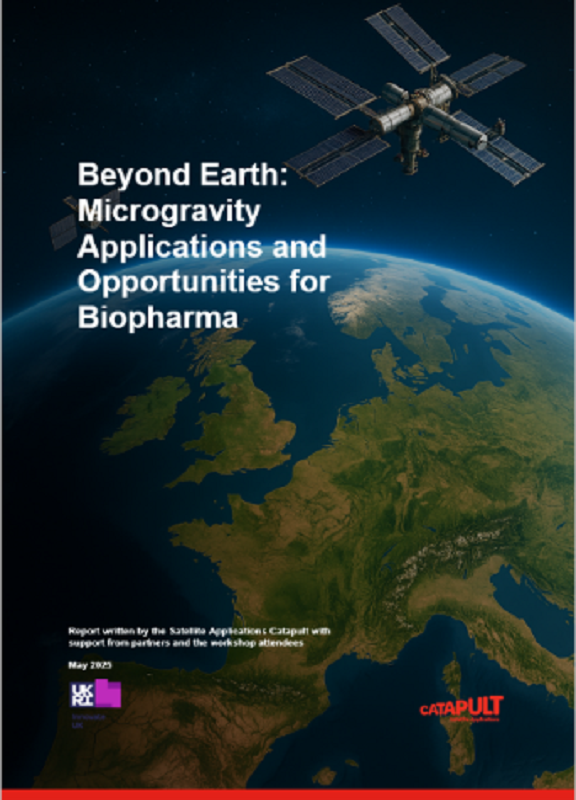
Space-based manufacturing ‘will be key’ in future
Space-based research has previously enabled breakthroughs in 3D bio-printing, where human tissues are printed in microgravity to create structures that cannot be formed on Earth. Such developments could potentially lead to organ printing for transplantation and regenerative therapies. Studies in protein crystallisation and nanomaterial formation also offer insights into drug formulations to improve patient outcomes.
Researchers are also leveraging the rapid ageing effects seen in microgravity to accelerate biomedical research. Cells and tissues age faster in space, allowing scientists to study degenerative conditions as well as test anti-aging treatments in shorter time-periods than required on Earth.
With the ongoing collaboration between agencies such as NASA, the UK Space Agency, and private biotech firms, space is quickly becoming a promising means of developing novel therapeutics within the pharmaceutical industry.

“As commercial access expands, space is becoming a laboratory for innovation,” Said Dr Braddock.
“This offers the pharmaceutical industry an opportunity to design products and treatments that were once unheard of.”

He concluded: “As populations live longer, the need for faster and more effective therapies is critical. Space-based manufacturing and research will be key to develop the next-generation healthcare solutions.”
Dr Braddock finished his visit with a question and answer session that delved even deeper into the subject matter; with some enlighten questions raised by the society members present. We look forward to Dr Braddock returning next year.