


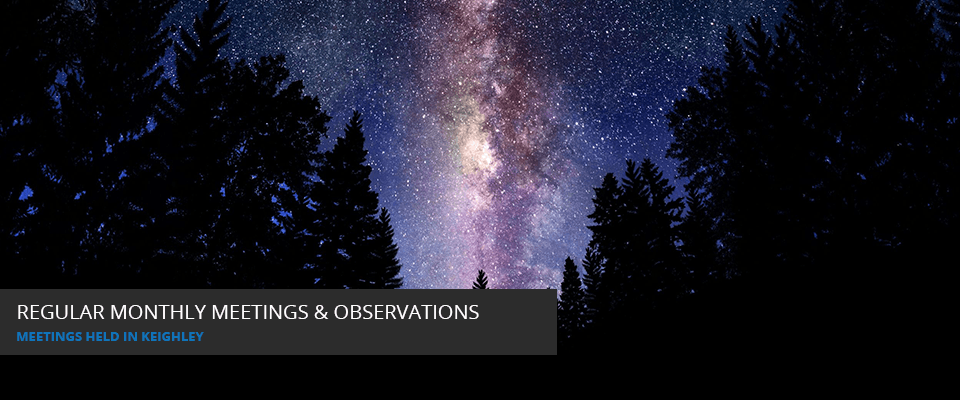
A full Moon and the Milky way over the Yorkshire Dales
The September night sky
September is the first month of autumn and change. The nights become longer, which mean longer nights for observing, but that is often curtailed as we move towards unsettled weather.
After months as a brilliant Evening Star, Venus drops out of sight, this month.
On 9th September you may if your fortunate catch a few meteors streaming outwards from the border of Pisces and Aquarius in the 45P-id meteor shower. The Earth will be crossing the path of a smattering of dust partials shed by comet 45P?Honda-Mrkos-Pajdusakova in 1927.
This month on Monday, 23rd September we have the autumn equinox.
At this moment 5.49pm; the instant of the September equinox, the midday sun will be at zenith, or straight overhead, at the Earth’s equator.
This is the first month of autumn and as the nights become longer and we move towards unsettled weather, we have the watery constellations dominating the heavens. Aquarius the water carrier, Cetus the sea monster, Capricorns the sea goat, Pices the fishes, Piscis Austrinus the southern fish and Delphinus the Dolphin.
Other autumn constellations are starting to show. Ursa Major, or the Plough, can be found low in the North. The ‘W’ of Cassiopeia is not far from the overhead point.
The summer triangle of Altair, Deneb and Vega remains high up. The southern sky is dominated by the Square of Pegasus. The bright star Capella in the constellation of Auriga the Charioteer is becoming more noticeable in the east. It will be overhead in winter evenings.
Although the four stars that form the Square of Pegasus are not the brightest, once found they will be easily recognised again. It is always an interesting project to count how many stars you can see within the square; you might be surprised by the result.
If you use the two right hand stars of the square and draw a line to the south you will reach a bright star very low in the sky. This star is Fomalhaut, in the constellation of Piscis Austrinus.
The Planets:-
MERCURY
The innermost planet will be to close to the Sun this month for observation.
VENUS
Starting the month just below the bright star Spica, Venus will be setting around 8pm dropping rapidly into the dusk twilight as the month progresses. The crescent Moon lies to its left on the 14th of this month. Observing through a small telescope of a good pair of binoculars, you can see the planets crescent growing thinner as Venus starts to swing between the Earth and the Sun. The evening star reaches its maximum brilliance of magnitude –4.8 on the 22nd of September, just as it disappears into the Sun’s glare.
MARS
Rising above the horizon about 1am, the red planet moves rapidly through the stars of Gemini during the month. Shinning at magnitude +1.2 Mars is about the same brightness as the constellations leading stars Castor and Pollux. On the morning of the 7th the crescent Moon lies to the left of Mars with the stars Castor and Pollux above. The red planet is directly in line with the twin stars in the early hours of the 25th of the month.
JUPITER
The gas giant planet is now brilliant in the morning sky, rising about 3am and blazing away at magnitude –1.8 in the constellation of Cancer. The crescent Moon is nearby on the 8th and 9th of September.
SATURN
The ring world is shinning at magnitude +0.4 this month in the constellation of Cetus. On the 26th and 27th of the month the full Moon is near to Saturn.
URANUS
Found in the constellation of Taurus. It rises above the horizon about 9.30pm. At magnitude +5.7 it is just visible to the naked eye, but is much better seen with at good pair of binoculars or a low power telescope.
NEPTUNE
Located ten degrees to the right of Saturn in the constellation of Pisces, the outermost planet reaches opposition and its closest point to the Earth on the 25th of this month. It will be visible all night long, with a magnitude of +7.7. Even at its brightest, Neptune is too faint to be seen without and optical aid.
PLUTO
This distant planet can be observed in a ten-inch or larger telescope. It can be found in the constellation of Capricornus, at magnitude +14.5. It will be setting below the horizon just after 1.30am.
CERES
The largest object in the asteroid belt can be located in the constellation of Gemini. Rising just before midnight and visible until dawn. At magnitude +8.8 it should be visible through binoculars or a low power telescope.
Special Events: –
2nd and 3rd September – The almost half Moon will be near the Pleiades star cluster.
7th September – The crescent Moon will be near the planet Mars after midnight.
8th September – The crescent Moon will be passing in front of the stars of M44 Beehive star cluster with bright Jupiter very close nearby.
9th September – The thin crescent Moon will be close to the planet Jupiter.
14th September – The crescent Moon will be near the planet Venus.
17th September – The half Moon will be near the star Antares.
26th September – At 5.49pm the Full Moon will be near the planet Saturn.
27th September – the almost full Moon will be near the planet Saturn.
30th September – The Moon with be near the Pleiades star cluster.
The phases of the Moon for September are:-
Last quarter 4th September
New Moon 11th September
First quarter 18th September
Full Moon 26th September