



This month sees the second of this years three Supermoons, and we will have the opportunity to see three Meteor showers.
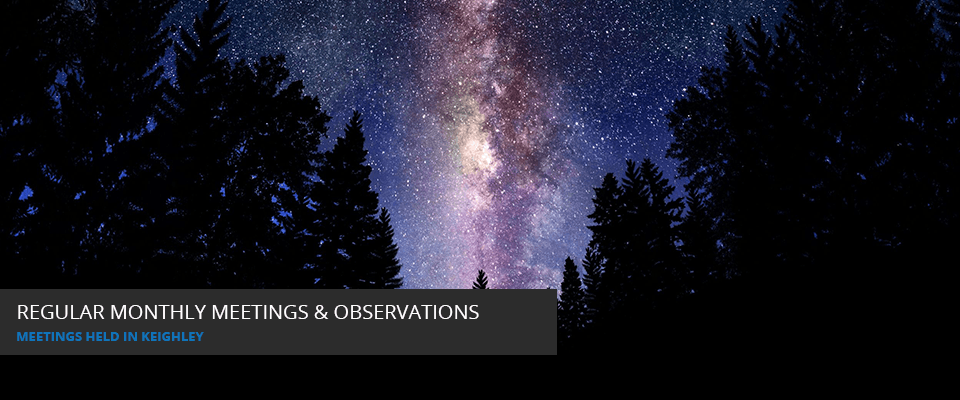
The Milky Way rises overhead on these dark November nights, providing a stunning inside perspective on the huge Galaxy that is our home in the cosmos. After your eyes have adjusted to the dark you should be able to see that it’s spangled with fuzzy glowing diadems. Better still, sweep the band of the Milky Way with binoculars or a small telescope, and these blurry jewels appear in their true light as distant clusters of stars.
November is the first month of long nights and we are starting to see the familiar winter constellations. Orion the Hunter appears in the sky just before midnight. Just to the right of Orion is Taurus the Bull with the bright red star Aldebaran and the star cluster the Pleiades or ‘Seven Sisters. They too are now becoming more conspicuous. This is the best time to look for the autumn constellations during the evening; the Plough is low in the north and the ‘W’ of Cassiopeia overhead. The summer triangle stars Altair, Deneb and Vega are now becoming low in the west.
If you look to the south the Square of Pegasus is very prominent; a line drawn from the top left hand star of the square shows a line of stars that form the constellation of Andromeda.
Take advantage of the moonless nights this month to observe the most distant objects visible with the unaided eye. Anywhere away from the glare of streetlights, you will see the misty blur of the great Andromeda Galaxy, the nearest large galaxy to us at 2.5 million light years away. Another challenge is to try and find the fainter Triangulum Galaxy, located below Andromeda. This is one of the few constellations that look like the figure they are supposed to describe Triangulum the Triangle. The light we see from this galaxy left it almost three million years ago.
Using the two right hand stars of the Square of Pegasus draw a line down for some distance to find Fomalhaut, the brightest star in the constellation of Piscis Austrinus (the Southern Fish).
The Planets:-
MERCURY
During the second half of November the innermost planet puts on its best morning appearance of the year, shinning at magnitude –0.5. It rises above the horizon about 5.30am. Located to the lower left of Venus. Mercury will be at its greatest elongation on the 20th of the month.
VENUS
The morning star roars into view reaching its maximum brilliance of magnitude –4.9 on the 27th of the month, when it will be rising as early as 4am.The thin crescent Moon forms a lovely duo with Venus on the morning of 7th November right next to the bright star Spica. For the rest of November Venus then loops around Spica.
MARS and JUPITER
Both planets are in the constellation of Leo this month near the star Regulus. Rising above the horizon about 11pm. Jupiter, with a magnitude of –2.0, is ten times brighter than the red planet; which is at magnitude +0.6. At the start of this month, Mars is higher in the sky, but its heading rapidly downwards and passes to the left of Jupiter on the 16th November. The half Moon lies nearby on the morning of 2nd and 3rd of this month, and on the evenings of 29th and 30th of November.
SATURN
The only planet easily visible in the evening sky is Saturn. Shinning at magnitude +0.5. It is located in the constellation of Cetus and will be setting below the horizon on 20th of the month. The almost full Moon will be just to the right of the ring world with Neptune between them.
URANUS
The gas giant planet is closest to the Earth on 26th November, the day after it is opposite to the Sun. Above the horizon all night long, Uranus can be found in the constellation of Taurus, between the star Aldebaran and Pleiades star cluster. It will be reaching its maximum brightness of magnitude +5.6 this month. Uranus is visible to the naked eye under good seeing conditions, especially as its currently high in the sky.
NEPTUNE
You will need good binoculars or a telescope to track down Neptune. Shinning with a measly magnitude of +7.7 Neptune lies on in the constellation of Pisces, and will fall below the horizon around 2.30am.
PLUTO
This distant planet can be observed in a ten-inch or larger telescope. It can be found in the constellation of Capricornus. With a magnitude of +14.6, it falls below the horizon around 8.30pm.
CERES
This dwarf planet in the asteroid belt planet can also be observed using
a ten-inch or larger telescope. It can be found in the constellation of Gemini at magnitude +7.9. It rises about 7.40pm and sets around half past midnight.
Meteor showers:-
There are two meteor showers this month. The Taurid meteor shower consists of slow moving meteors that often produce spectacular fireballs and is visible from November 5th to 9th. On November 17th to the 18th the Leonid meteors will be on display. The fiery remnants of Comet Temple-Tuttle, will be best seen after moonset at 11.30pm.
Other special events:-
2nd November – The crescent Moon lies above the planets Mars and Jupiter and the star Regulus.
3rd November – The crescent Moon lies below Jupiter, Regulus and Mars.
7th November – Before sawn breaks the crescent Moon teams up with brilliant Venus and the bright star Spica.
16th November – Mars passes a degree to the left of Jupiter.
20th November – The Moon is near the bright planet Saturn. Before dawn Mercury reaches its greatest morning separation from the Sun.
24th November – We have the second Super Moon of the year.
25th November – Uranus is opposite to the Sun.
26th November – Uranus is closest to the Earth at 2,759 million kilometres. Mars passes 1.5 degrees to the left of Regulus.
27th November – Venus is at its greatest brilliance as a Morning star.
28th November – The almost full Moon passes in from of the Beehive star cluster M44.
29th November – The Moon lies close to Jupiter, Mars and the star Regulus.
30th November – The Moon is just below Jupiter, Mars and Regulus.
Phases of the Moon:-
Last quarter 1st November
New Moon 9th November
First quarter 17th November
Full super Moon 24th November