



Professor Christopher Davies is formally welcomed to Keighley astronomical society
Professor Christopher Davies from ‘The school of the Earth, and Environment at the university of Leeds, was the guest speaker at the monthly meeting of Keighley Astronomical society held on Thursday 27th March 2025. This was Prof Davies first visit to our society and he delivered a presentation on the ‘different evolutions of the Earth, Mercury and Mars, at a well attended gathering of society members.
Professor Davies stated that the Earth, Mercury, and Mars, though all terrestrial planets, have evolved quite differently due to their size, proximity to the sun, and geological processes. Earth, with its active plate tectonics and abundant water, has a dynamic surface, while Mercury’s smaller size and lack of water led to a more heavily cratered, geologically inactive surface. Mars, being an intermediate size, has a single plate but is also heavily cratered and has undergone a period of global volcanism.
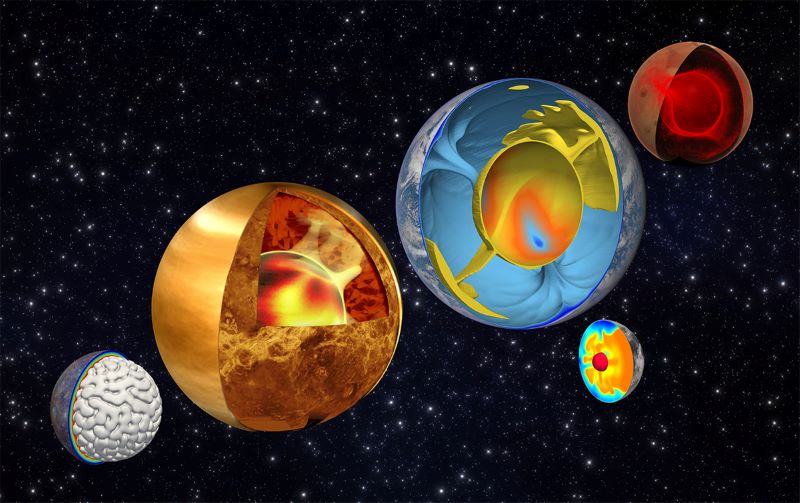
typical convection patterns in the interior of the terrestrial bodies of our Solar System. From left to right: Mercury, Venus, Earth and the Moon, and Mars.
Prof Davies explained in more detail the evolution of these three planets. This is a breakdown of his major points:-
Earth:
Early Formation:
Earth formed approximately 4.54 billion years ago through accretion from the solar nebula.
Active Plate Tectonics:
Earth’s surface is characterized by plate tectonics, where the lithosphere is divided into plates that move relative to each other, causing earthquakes and volcanic activity.
Presence of Water and Life:
The presence of liquid water and the evolution of life have profoundly shaped Earth’s surface and atmosphere, influencing geological processes and the planet’s habitability.
Dynamic Surface:
Earth’s surface is constantly changing due to plate tectonics, erosion, and deposition, creating diverse landscapes and geological features.

Mercury:
Early Formation and Rapid Cooling:
Mercury formed around 4.5 billion years ago and cooled rapidly due to its small size.
Lack of Plate Tectonics:
Mercury lacks plate tectonics, and its surface is heavily cratered, with evidence of ancient volcanism and faults.
No Global Magnetic Field:
Mercury does not have a global magnetic field, unlike Earth, which protects it from harmful solar radiation.
Sparse Atmosphere:
Mercury has a very tenuous atmosphere, meaning its surface is constantly bombarded by solar wind and micrometeorites.
Geologically Inactive:
Mercury’s surface is largely geologically inactive, with limited evidence of ongoing geological processes.

Mars:
Early Formation and Slow Cooling:
Mars formed around 4.5 billion years ago and cooled more slowly than Mercury, allowing for a more complex geological history.
Single Plate Structure:
Mars has a single lithospheric plate, which is thick and old but geologically diverse.
Evidence of Past Volcanism and Water:
Mars exhibits evidence of past volcanic activity and water, including ancient riverbeds and polar ice caps.
Atmosphere:
Mars has a thin atmosphere composed primarily of carbon dioxide, which is not dense enough to protect the planet from solar radiation.
Geologically Diverse:
Mars has a more geologically diverse surface than Mercury, with a combination of craters, volcanoes, and impact basins.
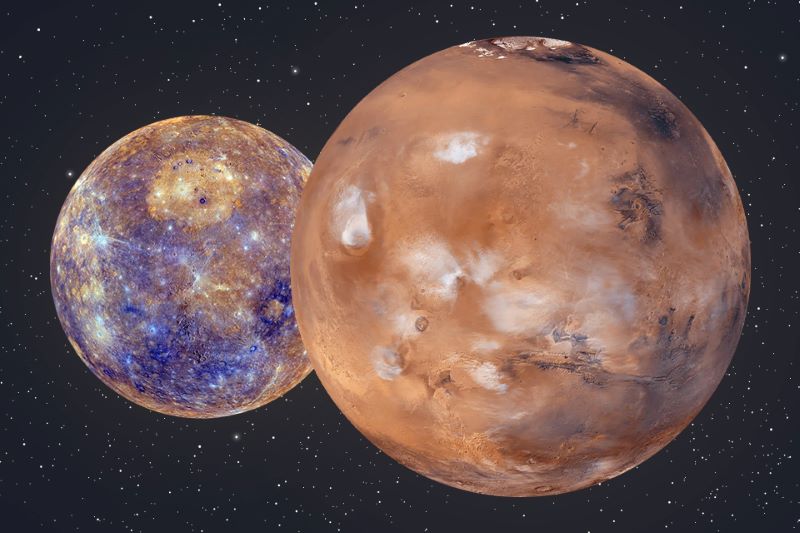
Mercury and Mars