


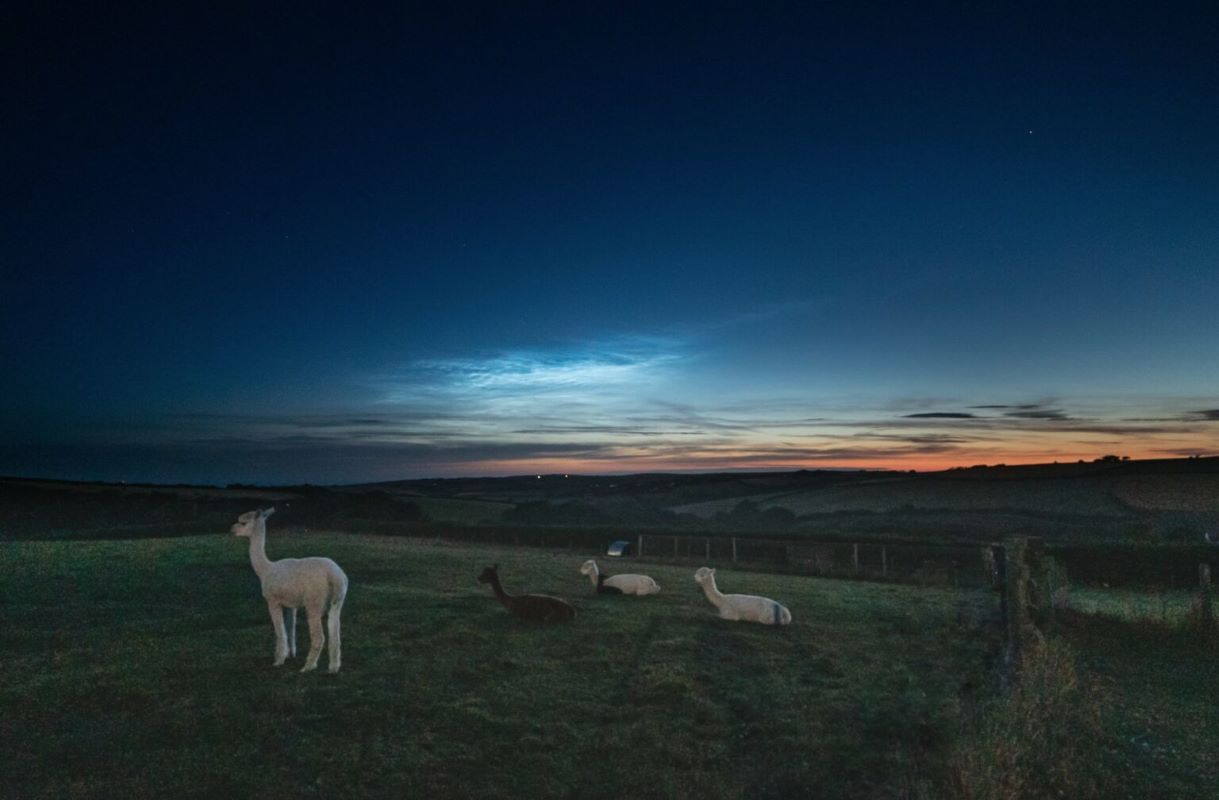
Noctilucent clouds above Lower Wensleydale
This is the mid point of the year and June brings our summer solstice on the 21th of this month.
This time of year the night sky is never quite getting dark. It’s not the greatest month for spotting faint stars. Only the brightest stars can be seen. You can take advantage of the soft, warm weather to acquaint yourself with the summer constellations of Hercules, Scorpius, Lyra, Cygnus and Aquila. And watch Venus and Mars as they encounter the star cluster known as the Beehive
Look for the bright stars like Vega in Lyra, which is high in the eastern sky, as is the Summer Triangle it forms with Altair in Aquila and Deneb in Cygnus returns to prominence.
There are two very nice objects to spot with binoculars in the eastern sky well after dark this month. Two thirds of the way up the right hand side of the 4 stars that make up the “keystone” in the constellation Hercules is M13, the best globular cluster visible in the northern sky.
Just to the left of the bright star Vega in Lyra is the multiple star system Epsilon Lyrae often called the double-double. With binoculars a binary star is seen but, when observed with a telescope, each of these two stars is revealed to be a double star – hence the name!
The Sun follows a shallow arc below our North horizon overnight, the geometry allowing views of noctilucent clouds, whose silvery-blue tracery may gleam low down between the northwest after nightfall and the northeast before dawn. Noctilucent clouds are formed by ice crystals coalescing around dust particles. They float near 82km in altitude where they reflect sunlight after our normal clouds are in darkness.
The Planets:-
MERCURY
During the first half of June, the innermost planet is just above the horizon, to the lower right of Venus and Jupiter. On the 15th of the month it will be at is greatest elongation from the Sun. Falling below the horizon around 11pm Mercury fades from magnitude –0.5 to magnitude +0.6 on the 16th June, when the crescent Moon will be right above the planet.
VENUS
Glorious Venus will be staying above the horizon until midnight. Located in the west shinning at magnitude –4.0. The evening star will be moving upwards as the month progresses. Venus passes just 1.5 degrees from Jupiter on the 9th of the month. The crescent Moon is very close by on the 17th, and on the 19th, Venus is just above the Beehive star cluster. That will be a lovely sight using binoculars or a low power telescope.
MARS
Mid-month the red planet appears in the north eastern dawn twilight about 3am. Located on the constellation of Taurus. Mars passes below the Pleiades star cluster on the 29th of the month.
JUPITER
The gas giant planet is in the same area of the sky as Venus, but some eight times fainter. It is at a magnitude of –1.8, and is still brighter than any of the stars. Located in the constellation of Gemini, in line with its main two stars Castor and Pollux. Jupiter falls below the horizon about 11pm.
SATURN
The ring world is now prominent in the morning sky, rising above the horizon about 2am at a magnitude of +0.8. Saturn is located on the borders of Pisces and Cetus. On the 10th of this month it is close to the crescent Moon.
URANUS
Uranus will be too close to the Sun for observation this month
NEPTUNE
Also rising around 1.30am, Neptune, shinning at a magnitude of +7.8 lies to the right of Saturn in the constellation of Pisces. You will need a low power telescope or more will be required to spot it.
PLUTO
This distant planet can be found in the constellation of Capricornus. Although it will always be low down and only visible in a ten-inch or larger telescope in a truly dark sky. The dwarf planet rises around 1.30am and is at magnitude 14.5.
CERES
The largest object in the asteroid belt can be located in the constellation of Taurus this month. At magnitude 8.9 it rises around 4am.
Special Events:-
10th June – The crescent Moon lies above the planet Saturn
13th June – Before dawn low on the horizon, to the right of the crescent Moon will be the Red Planet Mars.
16th June – Mercury lies immediately below the crescent Moon, with Venus and Jupiter to the upper left.
17th June – Venus and the crescent Moon form a dazzling duo in the evening sky after sunset; less than a degree apart. Jupiter lies to the lower right, with Mercury further down on the horizon.
19th June – The crescent Moon is near the star Regulus.
23rd June – The Moon is near the star Spica.
27th June – The almost full Moon is near the star Antares.
Phases of the Moon for June:-
Last quarter 8th June
New Moon 15th June
First quarter 21st June
Full Moon 30th June