


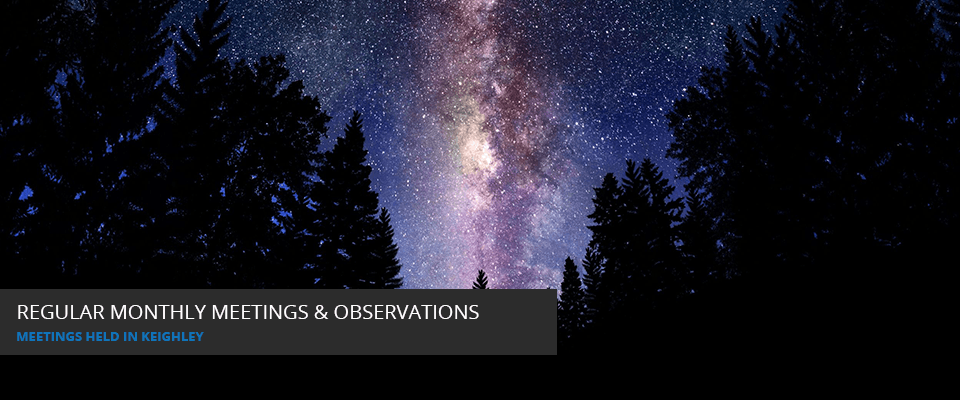



On February evenings, our sky is filed with more brilliant stars than we can see in any other month.
This month we have not just one evening star, but two. Venus is joined by elusive Mercury, putting on its best show of the year. Add in the four outer planets, and this month we have the chance to view all the worlds of the Solar System in the evening sky; except Mars which will be too close to the Sun.
The first signs of spring are now on the way, well as far as the night sky in concerned. The winter star patterns, Orion, Taurus and Gemini, are drifting westward as a result of our annual orbit around the Sun. Leo and Bootes are rising higher in the east.
The Plough is now higher in the north east, with its handle pointing in the general direction of the horizon. If you follow the curve of the handle you will come to a bright orange star low in the sky. This is Arcturus in the constellation of Bootes. Arcturus is the brightest star in the spring sky.
The ‘W’ of Cassiopeia is high in the north west.
Orion still dominates the southern part of the sky. However, as Orion is a little to the west of south, now is the best time to see Sirius the Dog Star. This is the brightest star in the sky. Using the three stars that form Orion’s belt to form a line, continue down that line and you will reach Sirius.
The stars are a very long way away. Sirius, although the brightest, is in fact very close to us, at around 8.5 light years away.
The other winter stars, Aldebaran and the Seven Sisters in Taurus are now starting to get lower in the west, while Castor and Pollux together with Procyon are now at their highest points. Capella is still high, being just past the overhead position. However, while Capella is very high, Vega, which occupied the overhead point in summer, is now at its lowest, close to the northern horizon.
The Planets:-
MERCURY
From about 8th February, you can see the innermost planet well to the right of Saturn. Mercury is putting on its best evening performance of the year, as it slowly fades from magnitude –1.1 to –0.4. It falls below the horizon about 7pm. On the 19th Mercury is at its greatest separation from the Sun.
VENUS
Around the middle of February, the evening star appears below Mercury and on 18th and 19th the crescent Moon makes a spectacular appearance with Venus, Mercury and Saturn. Venus shines at magnitude –3.9 and towards the months end as Mercury continues to grow dimmer she dominates the western evening sky until it sinks out of view around 7.45pm.
MARS
The red planet will be too close to the Sun for safe observation this month.
JUPITER
The gas giant is prominent against its nearest stars, shinning at magnitude –2.5. Located in the constellation of Gemini. It will be visible until around 5.30am. The Moon will be nearby on the 26th and 27th of the month.
SATURN
At the beginning of this month the ring world is the only planet visible to the naked eye in the west after sunset. Shining at magnitude +1.0, it lies in the dim constellation of Pisces and sets below the horizon around 8pm. On the 19th February the slim crescent Moon will be just to the right of Saturn with Mercury and Venus below it.
URANUS
This distant world is just on the edge of naked eye visibility at magnitude +5.8. It is usually difficult to identify among the background stars. This month Uranus can be found in the constellation of Taurus. It falls bellow the horizon around 1.30am.
NEPTUNE
The outermost planet can be found in the constellation of Pisces this month and sets below the horizon about 8pm. Shinning at a dim magnitude of +7.8 you will need binoculars or a telescope to see it. Neptune and Saturn are in the same area of the sky at the moment with Neptune above the ring world at the start of February. Saturn continues moving upwards and passes the outermost planet on the 20th. This will give you a great chance to locate and identify Neptune using binoculars or a low power telescope the faint greenish star, 50 arcminutes to the right of Saturn
PLUTO
This distant planet is located in the constellation of Capricornus. At magnitude +14.5 it will be below the horizon during the hours of darkness this month.
CERES
The largest body in the asteroid belt can be located between constellations of Cetus and Pisces. At magnitude +9.3, it will be falling below the horizon around 10pm.
Highlights of the month:-
2nd February – The almost full Moon is near the star Regulus.
6th February – The Moon is near the star Spica in the constellation of Virgo.
11th February – The crescent Moon is near the star Antares.
17th February – There will be an annular eclipse of the Sun; but nothing is visible from our part of the world.
18th February – Low in the twilight glow in the west there will be a lovely sight of the narrowest crescent Moon lying between bright Venus and Mercury. Venus will be below the Moon and Mercury will be above the Moon.
19th February – In the west after sunset the crescent Moon will be just to the right of brilliant Saturn with Mercury and Venus below.
24th February – The bright 1st quarter moon will lie among some of our brightest stars. They are Capella, Betelgeuse and Aldebaran. They’ll also be near the Pleiades star cluster.
25th February – The waxing gibbous Moon will lie closer to the star Capella, from sunset until several hours after midnight.
26th February – The moon lies to the right of Jupiter with the twin stars of Gemini; Castor and Pollux above.
27th February – The Moon will be just below Castor and Pollux, with bright Jupiter to the right.
28th February – on the final night of the shortest month of the year the Beehive star cluster lies immediately below the Moon. A lovely combination using binoculars or a low power telescope.
Phases of the Moon this month are:-
Full Moon 1st February
Last quarter 9th February
New Moon 17th February
First quarter 24th February